


Blogs
API 6D vs. API 600: Which Valve Standard Does Your Project Need?
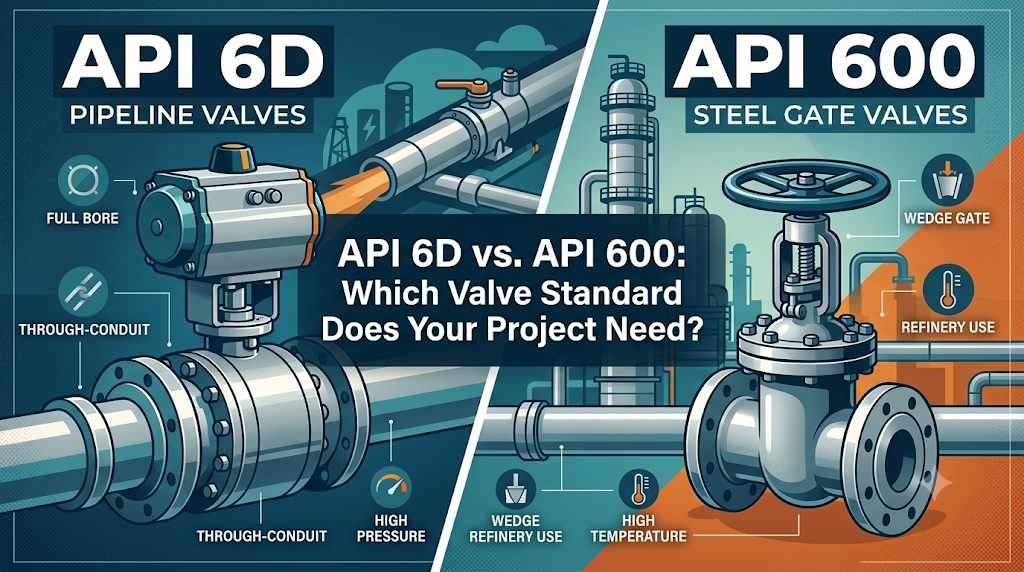
American Petroleum Institute is a global standard for valves, where piping systems have to follow the conditions. These conditions are regarding the size, type, working conditions, piping distance, and even the sealing type of valves. Even API standards are divided into API 600 and API 6D. They both appear similar until you look at their core differences. So, here is the guide you need before you go ahead and choose one of them.
API 6D Standards
Starting with the API 6D standards, we will discuss every factor that can help you understand better. This standard provides support for higher valve sizes, versatile valves, and long-distance piping systems. You will understand better by reading the details below.
Compliance
API 6D standards comply with multiple types of valves, such as ball, gate, check, and plug valves. You will find that these types of valves are best suited for long-distance piping systems. Likewise, API 6D complies with parallel gates in valves. Similarly, it is compatible with pipeline pigging because the above valve types can withstand pipeline pigging operations.
Tests Requirements
They need seat testing and also hydrostatic testing. These are mandatory tests that provide assurance for a long-distance piping system. API 6D requires longer tests for long-distance pipeline performance. They also require sour-service corrosion resistance against hydrogen sulfide gas. These are some challenges that occur, and API 6D valves can deal with them.
Applications
API 6D is best suited for transmission pipelines in the oil and gas sector. They can perform better in long-distance pipelines and also where quick shut-off functions are needed. For that purpose, the API 6D ball valve type works the best. Then there is another type, the API 6D plug valve, which provides bidirectional flow. Another type of API 6D is a check valve, which provides pump protection. Lastly, gate valves are the fourth type, which support pipeline pigging and isolation. These are all the types of API 6D valves.
Sealing Type
API 6D has double-block-and-bleed sealing. That sealing is compatible with different bolt diameters. There are some conditions where this sealing type makes API 6D an ideal choice.
Size Range
The size range of API 6D valves is from 1/2 NPS to over 60 NPS. This is why, when it comes to larger sizes, the API 6D standards fit the best.
Best Suited for
API 6D valve standards are best suitable for sealing and long-transportation of liquid and gas. They can provide support for a consistent flow of oil and gas for longer distances.
API 600 Standards
Then we have API 600 valve standards that have different performance and compliance with the oil and gas industry. There are some conditions that make these valve standards incompatible with long-distance piping and similar elements. Find out all the factors below.
Compliance
API 600 standard valves have rigid and elastic wedge-type single gate valves. These valves are suitable for heavy-duty performance. When it comes to challenging conditions, instead of a longer distance, these valves meet requirements. Therefore, they are not compatible with pipeline pigging tools.
Tests Requirements
They need seat testing and hydrostatic shell testing for excellent performance. This hydrostatic shell test ensures the valves are capable of handling extreme pressure and temperature.
Applications
When it comes to high-pressure petrochemical processing plants and refineries, API 600 valves are the best. They provide compatibility with refinery shutdown systems. These valves can withstand not only high pressure and temperature, but also high risk of corrosion and erosion. Industries select API 600 valves for their high sealing properties in extreme conditions. Challenging steam in high temperatures is not possible for any valve except API 600.
Sealing Type
They have wedge-to-seat compression sealing. This kind of sealing makes API 600 valves compatible with high-pressure and temperature conditions.
Size Range
The size range of API 600 valves is less than that of API 6D. The range starts from 1/2 NPS and ends at 26 NPS. Therefore, these valves are not compatible with long-distance piping systems.
Best Suited for
When choosing API 600 valves, you must know that they offer higher durability and heavy-duty performance against harsh pressure and temperature. So, when it is about such harsh conditions, API 600 is the best option.
Conclusion
The selection of API 600 and API 6D valves is not easy. They both look to be similar standards, but there is a huge difference between them. It is the difference in their applications. Due to applications, their working conditions and sizes also differ. A simple rule you can follow is that API 600 is for extreme pressure and temperature of gas and oil. API 6D is for long-distance piping and pigging systems. Besides, API 600 has only one type, which is a single gate valve of wedge type. API 6D has four types, which are ball, gate, plug, and check valves.
FAQs
Which API Valve Standard is Suitable for High Pressure and Temperature?
Choose API 600 for high pressure and temperature.
Which API Valve is Suitable for Above 26 or 60 NPS?
You need API 6D valves for NPS above 26 and even 60.
Should I Choose API 6D or API 600 for Pipeline Pigging Applications?
API 6D is compatible with pipeline pigging systems.
Which API Valve Standard is Ideal for a Long-Distance Pipeline?
API 6D is an ideal choice for long-distance pipelines.
Which API Valve Standard is Ideal for Double-Block-and-Bleed Isolation?
API 6D is ideal for double-block-and-bleed isolation.
Can I Use API 6D Valve for API 600 Valve or Vice Versa?
No, they are not alternatives. Their working conditions, sizes, and types are different from each other.
Recent Post
Leave Your Comments

Zhuhai Kunjian Technology Co.,Ltd

Have a question or need a quote? Fill out this form and our team will get back to you quickly!