


Blogs
Plug Valve vs Gate Valve
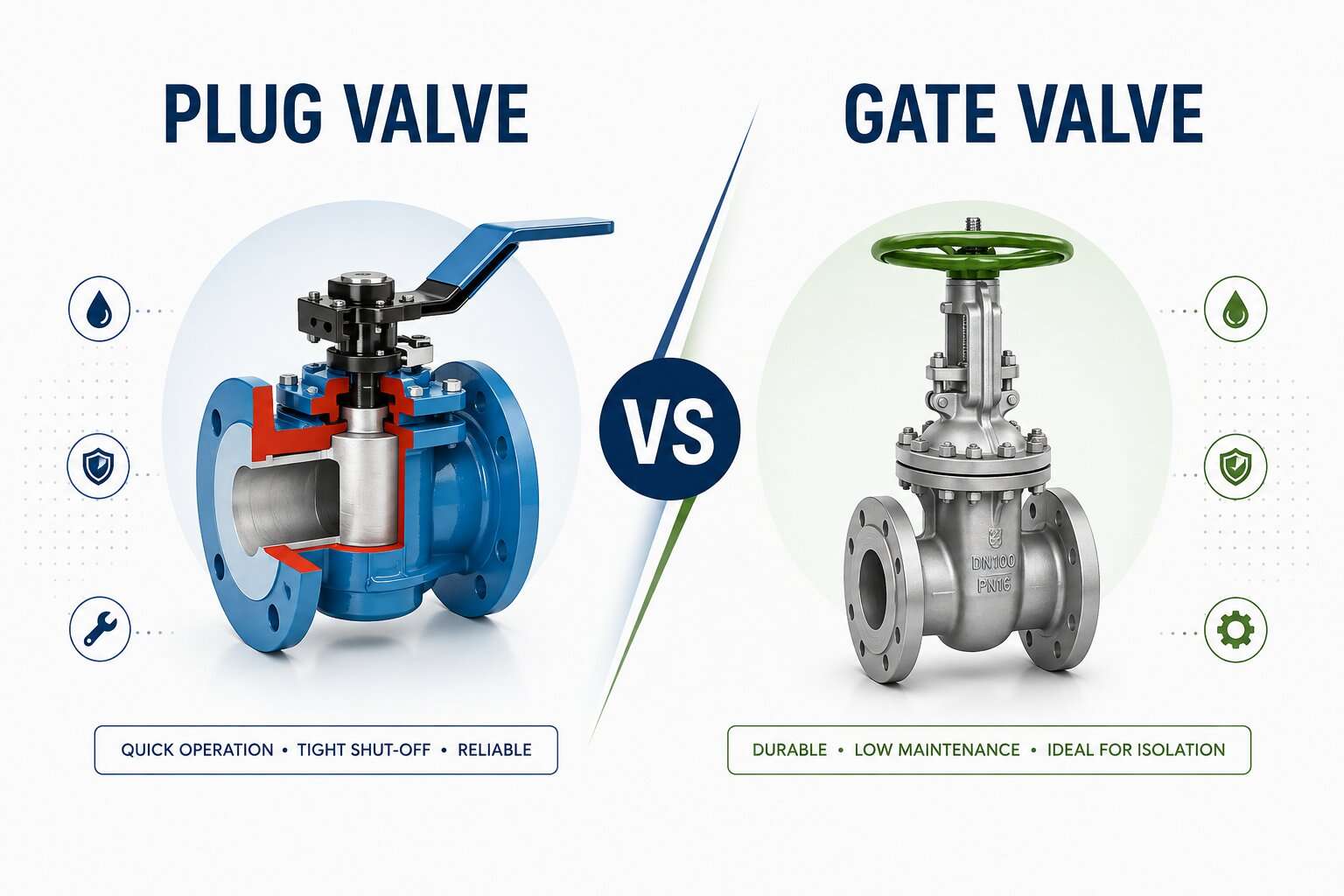
Plug valves and gate valves are both quarter-century-old shutoff designs, and both still dominate specific corners of industrial piping. The plug valve vs gate valve question comes up often because the two look similar on a spec sheet: both are stop valves, both handle a wide range of media, and both show up in gas, water, and process lines. The similarity ends at the closing mechanism, and that one design choice decides almost everything else — speed, debris tolerance, throttling ability, and maintenance.
How Each Valve Closes
A plug valve uses a plug with a hole bored through it. A quarter turn of the stem rotates the plug so the hole lines up with the ports (open) or turns 90 degrees away from them (closed). The plug sits across the full flow path at all times, whether open or closed.
A gate valve uses a flat or wedge-shaped gate that slides up and down, perpendicular to the flow. The handwheel or actuator drives a stem that raises the gate clear of the bore to open it, or lowers it into the seat to close it. Full travel usually needs several turns of the handwheel, not one quarter turn.
This difference in motion is the reason a plug valve opens and closes in a fraction of the time a gate valve needs.
Can a Plug Valve Throttle Flow? It Depends on the Port
Several supplier articles disagree on this point, and the disagreement comes from treating "plug valve" as one design when it is really a family of port shapes.
A plug valve with a standard rectangular or round port is built for on-off duty. Partially opening it exposes the plug and seat to a high-velocity jet, which wears the sealing surfaces over time — similar to what happens with a gate valve run in mid-position.
A plug valve with a diamond (venturi-restricted) port is a different story. The tapered shape of a diamond port changes flow area more gradually as the plug rotates, which gives it genuine throttling behavior across part of its travel. This is a specific product variant, not a feature of plug valves in general, so check the port type before specifying one for flow control.
A gate valve, regardless of disc type, should not be used to throttle. The gate hangs in the flow stream at partial opening, and the high-velocity flow around it causes vibration and erosion of the seat and disc. If your line needs ongoing flow adjustment, neither a standard plug valve nor a gate valve is the right tool — look at a globe or control valve instead.
Pressure and Temperature: What Actually Sets the Limit
A common claim online is that plug valves are a low-pressure option and gate valves are for high pressure. That's an oversimplification, and it matters because it can steer a buyer away from a valve that would actually work.
What really sets a plug valve's pressure and temperature range is its sealing method, not the "plug valve" category itself:
Lubricated, metal-seated plug valves use a sealant injected between the plug and body to maintain the seal under load. This construction is common in natural gas transmission and distribution, where plug valves are routinely specified at ANSI Class 600 and above — not a low-pressure niche application.
Non-lubricated, sleeve-lined plug valves (PTFE or similar liner) seal without injected lubricant. These are simpler to maintain but limited in temperature, since the liner material sets the ceiling.
For gate valves, the limiting factor is the bonnet construction. A screwed bonnet is the simplest and generally the lowest-pressure option. A bolted bonnet handles higher pressure and larger sizes. A pressure-seal bonnet, where body pressure actually tightens the body-bonnet joint, is used on the highest-pressure applications, commonly above 100 bar.
The practical takeaway: don't rule out a plug valve for a higher-pressure line without checking whether a lubricated, metal-seated design is available. And don't assume a gate valve is automatically fine at high pressure without confirming the bonnet type matches the service.
Sealing Against Debris, Grit, and Solids
This is where the two designs behave very differently in dirty service, and it's a factor most comparison articles skip.
A gate valve's disc travels in guide grooves inside the body. In media carrying sediment, grit, or scale, particles can settle into those grooves. Enough buildup prevents the gate from seating fully, and the valve won't go drip-tight — a known issue in storm drainage and raw water lines where double-disc gate valves are common.
A plug valve's rotating action works differently. As the plug turns through 90 degrees, it tends to wipe debris off the sealing surface rather than trap it in a fixed groove. This doesn't make a plug valve immune to solids — if debris bonds tightly to the seating surface, the extra torque needed to turn the plug can make it hard to operate — but it is structurally less prone to the groove-packing failure that affects gate valves.
For heavy slurry or fibrous solids (pulp stock, for example), neither standard design is the right answer. A knife gate valve, with its sharp-edged disc built to cut through the material, is the purpose-built alternative to both.
Design Variants
Plug valve variants:
Plug shape: cylindrical (larger opening, shorter service life) or tapered (smaller opening, generally longer-lasting)
Port type: rectangular, round, or diamond (throttling-capable)
Sealing: lubricated or non-lubricated
Port count: standard two-port, or multiport (3-way, 4-way) for diverting service
Gate valve variants:
Disc type: wedge (angled sealing faces, strong wedging action), knife (for thick fluids and solids), double-disc (two discs expand apart for a tight seal), slab (single-piece bored gate)
Bonnet type: screwed, bolted, welded, or pressure-seal
Stem type: rising (visual position indication) or non-rising (compact, used where vertical clearance is limited)
One Valve, Multiple Lines: Multiport Plug Valves
A feature gate valves simply can't match is the multiport plug valve. A single 3-way or 4-way plug valve can route flow between multiple lines — functions that would otherwise take two or three separate gate valves plus the piping to connect them. This is common in transfer and diverting service, where switching a flow path between tanks or process lines is a routine operation rather than a rare event. If your application involves routing, not just isolating, a multiport plug valve is worth evaluating before you default to a bank of gate valves.
Where Each Valve Is Actually Used
Plug valves are the standard choice in natural gas distribution and transmission, where their quarter-turn speed matters for emergency shutoff and their lubricated-seat design holds up at distribution pressures. They also show up in digester and raw-sewage lines, where their lower sensitivity to debris packing is valuable.
Gate valves dominate steam service, high-pressure process headers, and water transmission mains, where the valve sits fully open for long stretches and the near-zero pressure drop of a full-bore gate matters for energy cost over a long pipeline run.
Cost, Installation, and Maintenance
A plug valve generally needs less installation height but has a longer lever arm relative to its body size, so lateral clearance for the handle (or actuator swing) needs checking during layout. A gate valve, particularly a rising-stem type, needs vertical clearance above the valve for the stem to travel.
Maintenance differs by mechanism, not just by schedule. Lubricated plug valves need periodic sealant injection, which is a quick procedure but one that has to be scheduled. Gate valves need periodic inspection of the seating surfaces, and because the gate and seat are less accessible than a plug valve's wetted parts, surface rework on a worn gate valve typically takes longer in the shop.
On upfront cost, a direct comparison at the same size and class varies by manufacturer and isn't reliable to generalize — get quotes for your specific size and rating rather than relying on a blanket rule.
Advanced Designs: Expanding Plug and Expanding Gate Valves
Both valve families have an "expanding" variant built for high-cycle, double-block-and-bleed (DBB) service, common in gas processing and pipeline pigging stations. A dual expanding plug valve combines a quarter turn with a small linear motion: after rotating, the plug expands outward into the seats, which means the sealing surfaces carry almost no friction during the turn itself — unlike a standard lubricated plug or a non-expanding gate, where the seats drag against each other every cycle. The same expanding principle applies to expanding gate valves. In smaller sizes, an expanding plug valve tends to be the more cost-effective option; in larger sizes, the face-to-face dimension of a gate valve can actually be shorter than an equivalent plug valve, which shifts the economics the other way. If your project involves frequent cycling and DBB isolation, this is worth a dedicated conversation with your valve engineer rather than a default pick.
How to Choose
Work through these in order:
How often will it cycle? Frequent operation favors a plug valve's quarter-turn speed. Set-and-forget isolation suits a gate valve.
What's the pressure and temperature class? Check the specific plug valve's seat construction (lubricated metal-seated vs. sleeve-lined) and the gate valve's bonnet type — don't assume either family is ruled out by pressure alone.
Does the media carry solids or sediment? Favor a plug valve's wiping action for grit and sand; move to a knife gate valve for heavy slurry or fibrous solids.
Do you need to throttle? Only a diamond-port plug valve offers real throttling. For anything else needing flow regulation, look past both plug and gate valves.
Do you need to route flow between multiple lines? A multiport plug valve can replace several gate valves in diverting service.
FAQs
Is a plug valve full bore?
It can be. Plug valves are available in full-bore and reduced-bore configurations; a full-bore plug valve has a bore close to the pipe's inside diameter, keeping pressure drop low.
Can plug valves be used for throttling?
Only plug valves with a diamond (venturi) port are designed for throttling. Standard rectangular or round-port plug valves are built for on-off service, and partial opening will wear the sealing surfaces over time.
Which valve seals better in dirty or gritty media?
A plug valve's rotating plug tends to wipe debris from the sealing surface. A gate valve's disc-guide grooves can trap sediment, which may prevent the gate from seating fully.
Are plug valves rated for high pressure?
Lubricated, metal-seated plug valves are commonly used at ANSI Class 600 and higher in gas transmission and distribution service. Non-lubricated, sleeve-lined plug valves have lower pressure and temperature limits, set by the liner material.
What is a multiport plug valve used for?
A multiport (3-way or 4-way) plug valve routes flow between multiple lines from a single valve body, commonly used in transfer and diverting service where several gate valves would otherwise be needed.
Which valve closes faster?
A plug valve, since it only needs a quarter turn. A gate valve needs several turns of the handwheel to fully open or close, which also makes it less prone to sudden pressure surges (water hammer) on closure.
Recent Post
Leave Your Comments

Zhuhai Kunjian Technology Co.,Ltd

Have a question or need a quote? Fill out this form and our team will get back to you quickly!