

Blogs
How to Choose the Right Check Valve
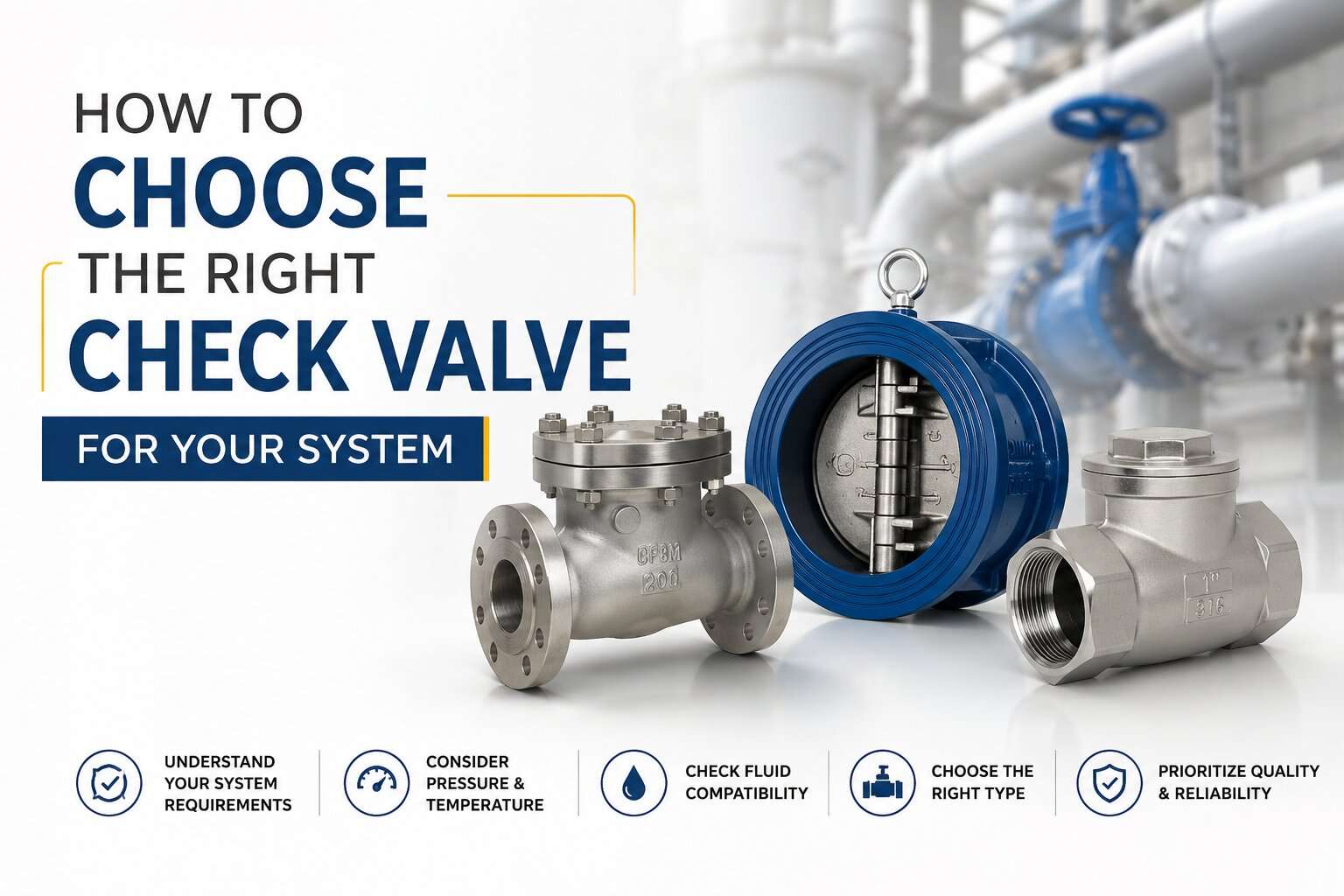
Choose a check valve by how your system behaves, not by line size. The right valve does three things. It opens fully and stays steady at your normal flow. It closes before reverse flow builds up. It suits your fluid, pressure, temperature and mounting position.
Work through those in order: define the duty, size for flow, match the closing speed to the pump, then settle type, orientation and materials. If you need the basics first, start with our primer on how a check valve works.
Why pipe size is the wrong starting point
A gate or ball valve, once open, takes its closure element out of the flow. A check valve does not. Its disc, ball or poppet moves with the flow, so its behavior depends on how much flow there is.
An oversized valve is the classic failure. At low velocity the disc cannot be held consistently open, so it flutters, and the repeated motion wears hinges, springs and seats. An undersized valve avoids that but raises pressure loss and can erode internals.
There is a second trap. Catalog Cv values assume the valve is fully open. If it is only partly open, the real pressure drop is higher than calculated and the full Cv is not available. For a check valve, a large rated Cv can work against you.
Step 1: Define the duty
Collect these before comparing any valve:
| Input | Why it matters |
|---|---|
| Fluid, solids content, viscosity | Drives type, seat and material, and fouling risk |
| Minimum, normal and maximum flow | Minimum flow decides whether the valve stays stable. Take it from the pump curve and operating modes, not from rated capacity |
| Operating and surge pressure, temperature | Sets pressure class, seat and spring limits |
| Pump or compressor type, trip behavior, number of pumps | Sets how fast flow decelerates and reverses |
| Orientation and straight run available | Restricts valve types and affects stability |
| Allowable head loss at the duty point | Sets the energy cost |
Step 2: Size for flow, not for the line
Different valve families stay open by different mechanisms.
Hinged discs (swing, dual-plate, tilting disc) need a minimum velocity to hold the disc against its stop.
Poppet, piston and ball valves need a minimum pressure drop to stay open.
Two screening figures help. For water, one valve-industry source puts the velocity that keeps a check valve fully open at roughly 10–12 ft/s (about 3–3.7 m/s), with the pressure drop needed to hold it open at two to five times the cracking pressure. For spring-loaded poppets, manufacturers advise at least 1 psi (about 0.07 bar) across the valve.
Treat these as screening values, not specifications. Thresholds vary by design, and Milwaukee Valve publishes separate sizing guidance for swing and silent checks. Get the real minimum from your manufacturer's data.
You may also see advice to size small check valves so maximum flow falls between 20% and 80% open. That guidance is written for miniature spring-loaded valves. It does not contradict the "fully open" rule for hinged discs, because they are different mechanisms.
- If your line size gives too little velocity, you have three options:
- Step down to a smaller valve with reducers, which adds some head loss.
- Switch to a design that opens at lower velocity.
- Accept partial opening only if flow is brief and intermittent.
Step 3: Match closing speed to your pump system
This step is where most selection errors start.
What slam really is
Slam follows pump stoppage. Flow reverses toward the pump before the valve has fully closed, and the closing valve then stops that reverse flow almost instantly. The bang is not mainly the disc hitting the seat. It is the pipe stretching under the resulting water hammer.
Two ways to avoid it
A valve must close very fast before appreciable reverse flow develops, or very slowly once it has. Fast closure needs low disc inertia, a short stroke or spring assistance. For comparison, silent and nozzle checks have a stroke of about a quarter of the pipe diameter, and a spring-assisted silent valve can close in about a tenth of a second. A resilient-hinge swing check closes through 35°, versus 60–90° for a traditional swing check.
Slow closure, for example with a dashpot, uses a different strategy and must accept the resulting reverse flow and possible pump backspin.
Why "fastest" is not the answer
Val-Matic's test work concluded that the answer is not to standardize on the fastest valve. The non-slam characteristics must be matched to the pumping system. The key system variable is deceleration, which in high-head or multiple-pump systems can reach about 40 ft/s² (12.2 m/s²).
A screening estimate you can run yourself
Surge pressure scales with the reverse velocity at the moment of closure (Joukowsky relation: ΔP ≈ ρ × a × v). For water in steel pipe, assuming a wave speed of about 1,000 m/s:
| Reverse velocity at closure | Approximate surge |
|---|---|
| 0.1 m/s | 1 bar |
| 0.5 m/s | 5 bar |
| 1.0 m/s | 10 bar |
This is a screening estimate only. Wave speed is much lower in plastic pipe, and long or complex lines need a transient analysis. A recent chilled-water design note shows the same effect: a fourfold difference in reverse velocity gives a fourfold difference in surge.
What a check valve cannot fix
A well-chosen valve removes delayed-closure slam. It cannot independently prevent water hammer caused by pump control, line geometry, column separation or another valve. Ask suppliers for dynamic closing data, meaning reverse velocity against deceleration, for your size and orientation. Not every manufacturer publishes it.
Step 4: Choose the type by scenario
| Scenario | Types worth screening | Reason | Watch for |
|---|---|---|---|
| Pump discharge, clean liquid, surge-sensitive | Silent/nozzle (axial), spring-assisted dual-plate | Spring closure before flow reverses | Higher head loss. Install a strainer ahead of the pump where solids are possible |
| Large bore, low head, steady flow, horizontal | Swing (resilient-hinge where available), tilting disc | Low loss when fully open | Slower closing. Needs adequate velocity |
| Raw wastewater, stringy or solids-laden | Full-port swing, ball check | A full-port swing check passes solids and stringy material and avoids a snagged hinge arm | Dual-plate designs: the centre spoke can collect debris in dirty water |
| Clean fluid, high pressure, guided closure | Lift / piston | Guided element, tight seating | Higher flow resistance. Body style fixes allowed orientation |
| Vertical flow | Spring-assisted axial designs | Closure does not rely on gravity or reverse flow | Vertical-down flow: consult the factory |
| Pulsating flow (reciprocating compressor or pump) | Piston or plate-type with low moving mass and damping | Rapid flow reversal each stroke | Swing checks are not suited to pulsating flow |
| Compact flanged layout | Dual-plate wafer | Short face-to-face | Spring wear, solids, minimum velocity |
| Hot or abrasive service | Metal-seated lift or swing | Metal seats tolerate extreme temperature and abrasion, but allow minor leakage | Confirm trim and spring materials |
For the two designs most often compared, see swing and lift check valves compared. Kunjian's lift check valve suits clean, higher-pressure duty where guided closure matters.
Step 5: Orientation and placement
Horizontal: works for most designs. Confirm the valve's marking if the line slopes.
Vertical flow up: a gravity-closing disc can slam when flow stops. Only axial, spring-closing designs perform well in vertical piping, according to one manufacturer. Check your own valve's limits.
Vertical flow down: the hardest case. Get written confirmation from the manufacturer.
Distance from pumps and fittings: manufacturers disagree. One asks for three diameters of straight pipe upstream, another for five diameters downstream of turbulence-causing fittings, and another for 5 to 10 diameters from elbows and pumps. Follow the strictest figure in your valve's installation manual. Turbulence upsets even a correctly sized valve, which is why flow disturbances upstream cause instability.
Position: install between the pump and its isolation valve, and leave room to open the cover for inspection.
Step 6: Materials, seats, ratings and standards
Ratings. Pressure–temperature ratings follow ASME B16.34. A body that passes on pressure can still fail on a spring, seat or seal that cannot take the temperature or the fluid. Check every wetted part. For carbon steel bodies, see our WCB flanged check valve.
Seat leakage. Expect different leakage from check valves than from shut-off valves. In API 598 testing, soft-seated valves must show zero visible leakage, while metal-seated valves are allowed a limited rate. A Crane Co. paper argues that shut-off leakage rates are not appropriate for check valves. Do not specify "bubble-tight" for a metal-seated swing check unless you accept the cost. Where positive isolation is needed, add a block valve in series.
Standards. API 594 covers wafer and lug check valves for process plants, while API 6D covers pipeline valves. If your project spec mixes standards, our note on how API 6D differs from API 600 may help clarify scope.
What head loss costs
Compare head loss at your duty point, not the fully open catalog value. Extra loss of 3 m at 200 m³/h, with a pump efficiency of 75%, takes about 2.2 kW (ρgQH/η). Over 8,000 operating hours that is roughly 17,400 kWh a year. A valve that opens fully at your flow, and a pipe that is not oversized, pay back through lower energy and less wear.
Worked example: pump discharge, clear water
Duty: DN150 line (assume 150 mm bore), 60 m³/h minimum, 90 m³/h normal, long line with a riser.
- Velocity in the line. At 90 m³/h: 0.025 m³/s ÷ 0.01767 m² ≈ 1.4 m/s. At 60 m³/h: 0.94 m/s.
- Compare with the screening figure of about 3 m/s for a swing check to stay open. A DN150 swing check would flutter.
- Options. DN100 swing check with reducers: 3.2 m/s normal, 2.1 m/s minimum. Borderline at minimum flow, and head loss rises.
- Spring-assisted axial check in DN150: opens at far lower velocity and closes quickly.
- Closing check. Suppose the swing valve lets 0.5 m/s of reverse flow develop. That is about 5 bar of surge. A spring-assisted valve limiting reverse velocity to 0.1 m/s gives about 1 bar.
- Decision. Select the spring-assisted valve. Confirm its minimum opening pressure drop, cracking pressure, Cv at duty and dynamic closing data. Install it at the distance your manual requires.
All figures are illustrative. Replace them with your manufacturer's curves.
What to send your supplier
Include these in the RFQ, and for more on qualifying suppliers see the guide to sourcing industrial valves:
- Fluid, solids, and the min/normal/max flow
- Operating and surge pressure, and temperature
- Line size, end connection and standard (API 594, API 6D, or project spec)
- Orientation and straight run available
- Pump type, trip scenario and allowable head loss
- Body, trim, spring and seat materials
- Seat leakage acceptance criterion and test standard
Request: minimum velocity or pressure drop for full opening, dynamic closing data, cracking pressure, and Cv at your duty point
FAQ
What happens if a check valve is too big?
The disc or poppet cannot stay seated against its stop. It flutters and wears out early, and head loss is higher than catalog values.
Can a check valve stop water hammer?
It can reduce hammer from late closure. It cannot stop surge caused by pump control, line geometry or other valves.
Can I install a check valve vertically?
Often yes, but only for designs rated for it. Vertical-down flow needs manufacturer confirmation.
What is cracking pressure?
It is the minimum upstream pressure needed to start opening the valve. It matters most in low-head systems and for spring-loaded designs.
Is a non-return valve the same as a check valve?
Yes. Both terms describe a self-acting valve that permits flow in one direction.
Next step
Send your duty data and we will review it. Kunjian's check valve range includes flanged swing check valves in DN40–DN600 (PN16, PN25 and Class 150). Dual-plate, axial-flow and ball types are available on request. Contact our engineering team with your RFQ data.
Recent Post
Leave Your Comments

Zhuhai Kunjian Technology Co.,Ltd

Have a question or need a quote? Fill out this form and our team will get back to you quickly!