

Blogs
What Is a Check Valve
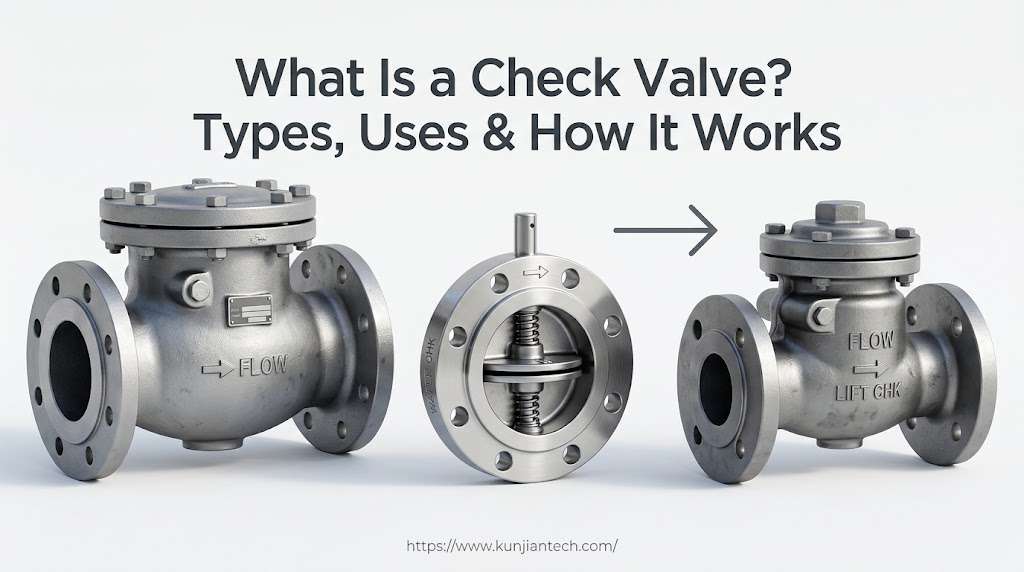
A check valve is a valve that allows fluid to move in one direction and stops it from flowing back. It works automatically, so there is no handwheel, actuator, or operator needed to control its normal opening and closing.
This simple function matters in many piping systems. Reverse flow can make a pump rotate backward, affect pressure conditions, move contaminated fluid into a clean section, or interfere with equipment connected to the same line. A check valve is used when the system needs flow to move forward without allowing it to return.
Check valves are also called non-return valves (NRVs) or one-way valves. However, the name alone does not tell you which design is suitable. Swing, ball, lift, wafer, dual-plate, and spring-loaded check valves behave differently and should be selected according to the actual service conditions.
What Does a Check Valve Do?
The main job of a check valve is to control flow direction automatically.
For example, consider a pump sending water into a pipeline. While the pump is running, water moves toward the discharge side. When the pump stops, pressure and flow conditions can change. Without suitable backflow protection, water can move in the opposite direction.
The check valve responds to that change and closes the flow path.
This makes check valves useful for:
-
Protecting pumps from reverse rotation
-
Preventing unwanted backflow in pipelines
-
Keeping fluid from moving between sections with different pressure conditions
-
Helping maintain the intended flow direction
-
Protecting compressors and other process equipment
A check valve is not normally used to regulate flow like a control valve. Its basic task is to permit flow when conditions are correct and stop it when flow tries to reverse.
How Does a Check Valve Work?
A check valve works through the pressure difference across the valve and the movement of its internal closing element.
The closing element may be a disc, ball, plate, piston, or another mechanism, depending on the valve design.
1. Forward Flow Starts
When pressure on the inlet side becomes sufficient to overcome the resistance inside the valve, the closing element moves away from the seat.
This creates a flow path through the valve.
The pressure required to begin opening is known as cracking pressure. It is an important specification for applications where the available pressure difference is low.
2. The Valve Remains Open
As long as the flow conditions support the open position, fluid continues through the valve.
The amount of restriction depends on the valve design. A poorly matched valve can add unnecessary pressure loss, especially when the system requires high flow.
This is one reason valve selection should not be based only on pipe size.
3. Flow Slows or Stops
When the upstream flow decreases, the force keeping the closing element open also decreases.
Depending on the design, gravity, a spring, reverse pressure, or a combination of these forces moves the closing element toward the seat.
4. Reverse Flow Is Blocked
If the flow attempts to move backward, the closing element contacts the seat and blocks the passage.
How quickly this happens is important. A valve that closes too slowly can allow reverse flow to build before sealing. A valve that closes abruptly can contribute to pressure surges known as water hammer.
What Are the Main Types of Check Valves?
Different check valve designs solve different flow-control problems. The right choice depends on factors such as media, flow conditions, installation position, pressure loss, required closing speed, and available space.
Swing Check Valve
A swing check valve uses a hinged disc that moves away from the seat when fluid flows forward.
Its relatively open flow path can make it useful where low pressure loss is important, particularly in larger piping systems.
The main point to consider is closing behavior. If the disc closes after significant reverse flow has started, the system may experience a pressure surge.
Ball Check Valve
A ball check valve uses a ball as the closing element.
Forward flow moves the ball away from its seat. When the pressure conditions change, the ball returns to the seat and blocks reverse flow.
This design can be useful for certain viscous or dirty-fluid services because there is no hinged disc mechanism. The actual suitability still depends on the media and valve construction.
Lift or Piston Check Valve
A lift check valve uses a disc or piston that moves along a guided path.
The design can provide controlled movement and is often considered for applications where pressure, temperature, or shutoff requirements make other designs less suitable.
Because the internal flow path can create more resistance than some other designs, pressure drop should be checked during selection.
Wafer or Dual-Plate Check Valve
A dual-plate check valve uses two plates that open under forward flow and move back toward the closed position when the flow changes.
The compact body makes this type useful where installation space and valve weight matter. Spring-assisted designs can also provide faster closing than some conventional swing designs.
Spring-Loaded or Inline Check Valve
Spring-loaded check valves use spring force to control the closing element.
The spring helps return the valve to its closed position when the forward pressure falls. This can make the design useful where installation orientation or faster response is important.
However, the spring also affects the pressure required to open the valve, so cracking pressure must be considered.
Foot Valve
A foot valve is installed at the inlet of a suction line and commonly includes a strainer.
It allows liquid to enter the suction line while helping prevent the liquid from draining back when the pump stops. This can help maintain the liquid column needed for pump operation.
Where Are Check Valves Used?
Check valves are found anywhere uncontrolled reverse flow can create a system problem.
Pump Systems
Pump discharge lines are a common application. When a pump stops, the check valve can limit reverse flow through the pump.
The valve type still needs to match the pump's flow rate, pressure, shutdown behavior, and piping arrangement. Pump systems are especially sensitive to closing speed because reverse flow and pressure surges can develop during shutdown.
Water and Wastewater Systems
Water supply, wastewater, and treatment systems use check valves to maintain the intended flow direction.
The choice depends on water quality, pipe size, flow velocity, installation arrangement, and the consequences of reverse flow.
HVAC Systems
Heating and cooling systems can use check valves to control flow between different parts of the system.
Here, pressure drop and installation orientation can matter because the valve becomes part of the system's overall flow resistance.
Chemical and Process Systems
Process piping may require check valves where different fluids, pressures, or process stages must remain separated.
Material compatibility becomes particularly important when the fluid can attack the valve body, seat, spring, or other internal components.
Oil, Gas, and Industrial Piping
Industrial piping can use several check valve designs depending on pressure, temperature, line size, media, and required closure behavior.
For these systems, the valve should be selected from actual operating conditions rather than simply choosing the same valve type used elsewhere in the plant.
What Materials Are Check Valves Made From?
Check valves are available in different materials because the valve must withstand the fluid and operating conditions around it.
Common choices include:
-
Stainless steel
-
Carbon or cast steel
-
Ductile iron
-
Cast iron
-
Brass
-
Bronze
-
PVC
-
CPVC
-
PP
-
PVDF
Material selection should consider more than the fluid name. Temperature, pressure, chemical compatibility, corrosion exposure, seat material, and applicable service requirements can all affect the final choice.
For example, a material that works well in a water system may not be suitable for a chemical process with a different temperature or chemical concentration.
How to Choose the Right Check Valve
Choosing a check valve starts with the system, not the valve catalog.
Before selecting a design, identify:
-
Fluid or media — Is the line carrying clean water, gas, oil, chemicals, slurry, or another medium?
-
Flow rate — The valve needs to operate properly at the actual flow range, not only the nominal pipe size.
-
Operating pressure — Check the normal and maximum pressure conditions.
-
Temperature — Body, seat, seal, and spring materials may have different temperature limits.
-
Pipe size and connection — Confirm the required valve dimensions and end connection.
-
Installation orientation — Some check valves have restrictions on horizontal or vertical installation.
-
Cracking pressure — Make sure the available pressure difference is sufficient to open the valve.
-
Closing behavior — Consider how quickly the valve needs to close when flow stops.
-
Pressure drop — A restrictive valve can increase the energy required to move fluid through the system.
-
Water-hammer risk — Pump shutdown and fast changes in flow can make closure behavior a critical selection factor.
Current engineering guidance also emphasizes that selecting a check valve by pipe size alone can lead to problems such as unstable movement, excess pressure loss, poor sealing, or damaging pressure surges.
Common Check Valve Problems
A check valve can be simple to operate but still cause problems when the design, sizing, or installation does not match the system.
Water Hammer
If a valve closes while fluid is still moving at significant velocity, the sudden change can create a pressure surge.
The solution is not simply to choose the fastest-closing valve. Closure behavior needs to match the piping system and operating conditions.
Valve Chattering
A check valve may repeatedly open and close when the flow conditions are not suitable for stable operation.
This can increase wear on the closing element and seat.
Excessive Pressure Drop
An unsuitable valve can restrict flow more than expected.
This may increase the pressure the pump needs to provide, reducing overall system efficiency.
Reverse Leakage
If the closing element or seat does not seal properly, some reverse flow may continue after the valve should have closed.
The cause can include wear, contamination, damaged sealing surfaces, incorrect selection, or unsuitable operating conditions.
Incorrect Installation
Installing a valve against the marked flow direction can prevent normal operation.
Orientation also matters because different check valve designs rely on gravity or spring force to control the closing element.
Check Valve vs. Non-Return Valve vs. One-Way Valve
In many industrial and plumbing contexts, check valve, non-return valve, and one-way valve describe the same basic function: allowing flow in one direction while restricting reverse flow.
The important difference is usually not the name but the actual valve design.
When buying or specifying a valve, confirm the technical details rather than relying only on the terminology used by a supplier. Check the flow direction, pressure rating, temperature range, materials, connection type, cracking pressure, installation requirements, and applicable specifications.
Frequently Asked Questions
Does a check valve stop all reverse flow?
A properly selected and installed check valve is designed to stop reverse flow, but actual sealing performance depends on the valve design, seat condition, media, pressure conditions, and service requirements.
Does a check valve need an actuator?
No. A conventional check valve operates automatically from the flow and pressure conditions in the line. Some specialized systems may use additional equipment, but an ordinary check valve does not require an external actuator.
Can a check valve be installed vertically?
Some designs can operate vertically, while others have orientation limits. Always confirm the manufacturer's installation requirements for the specific model.
What is cracking pressure?
Cracking pressure is the pressure difference required to begin opening the check valve. A spring-loaded design may require more opening pressure because the spring adds resistance to the opening movement.
How do I know which check valve type I need?
Start with the media, flow rate, pressure, temperature, pipe size, installation orientation, pressure-drop requirement, and risk of reverse flow or water hammer. Then compare suitable valve designs against those conditions rather than selecting by size alone.
Conclusion
A check valve has one basic job: keep flow moving in the intended direction and limit reverse flow automatically.
The difficult part is not understanding what a check valve does. It is choosing a design that behaves correctly under the actual conditions of the system.
Swing, ball, lift, dual-plate, spring-loaded, and foot check valves each have different operating characteristics. Media, pressure, temperature, flow rate, orientation, cracking pressure, pressure drop, and closing behavior should all be considered before a valve is specified.
For B2B buyers, engineers, and procurement teams, the right approach is to define the application first and then match the check valve to those requirements. That helps avoid problems such as excessive pressure loss, unstable operation, reverse leakage, and water hammer.
Recent Post
Leave Your Comments

Zhuhai Kunjian Technology Co.,Ltd

Have a question or need a quote? Fill out this form and our team will get back to you quickly!