


Blogs
The B2B Buyer’s Guide to Sourcing Industrial Valve
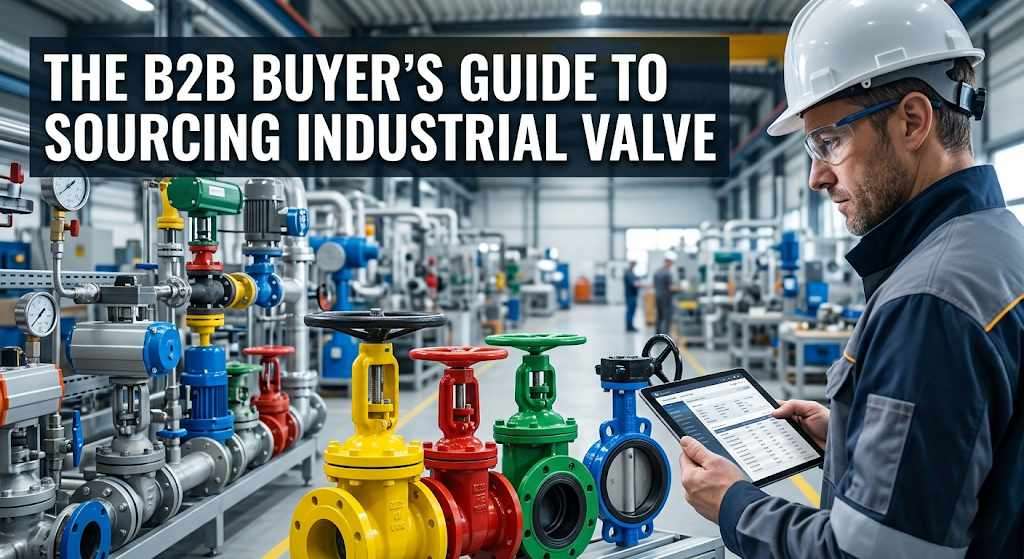
Industrial valves are essential flow-control components for pipeline systems in a variety of industrial sectors. They are the central component of some of the world's most crucial infrastructure. And yet, for all their operational importance, the procurement process around industrial valves is frequently taken non-seriously by procurement mangers until a specification error, or a supplier shortfall shuts down a project timeline.
This guide is specially written for procurement managers, plant engineers, and industrial equipment distributors who need a structured, and solid strategy for sourcing industrial valves, from understanding product fundamentals to evaluating a China valve manufacturer with confidence.
Understanding Industrial Valves: What B2B Buyers Need to Know First
Before you evaluate a single supplier, you need to understand what you are buying. Industrial valves are not interchangeable. The wrong valve type in the wrong application does not just underperform, it creates safety risks, compliance failures, and costly downtime.
Rotary valves include ball valves, butterfly valves, and plug valves, while linear valves include globe valves, gate valves, and diaphragm valves. Each category serves a distinct operational purpose.
Industrial ball valves, in particular, are widely used in fluid control systems due to their compact structure, quick operation, and reliable sealing performance. They are commonly applied in industries such as petrochemicals, water treatment, power generation, natural gas transmission, food processing, and pharmaceuticals.
Understanding the specific valve type your end-use application demands is not a preliminary step. It is the foundation of every sourcing decision that follows.
The Global Industrial Valve Market: Why Sourcing Strategy Matters More Than Ever
The market is growing. Fast. And so is the competitive pressure on supply chains.
Rapid expansion of oil and gas, power generation, water and wastewater treatment, and chemical processing industries is increasing the demand for reliable flow control systems, driving the adoption of industrial valves. Add to that the infrastructure modernization wave sweeping emerging economies, and you have a demand environment where supply disruptions carry real financial consequences.
Long-term market growth is being supported by increasing investments in LNG infrastructure, refinery modernization, hydrogen projects, industrial automation systems, and industrial decarbonization initiatives. These are not short-cycle projects. They represent multi-year procurement commitments, which means the supplier relationships you build today will define your operational reliability for the next decade.
Asia Pacific was the largest market for industrial valves in 2025, with a revenue share of 36.3%. Within that regional dominance, China's role is decisive. China accounts for about 35% of the world's manufacturing output, reasserting its position as the world's leading manufacturing hub.
Your sourcing strategy is not just a procurement exercise. It is a competitive instrument.
Key Specs Evaluate When Sourcing Industrial Valves
Material Specifications
Material selection is where many procurement teams make their first costly mistake. The material your valve is made from must be matched to the media it will handle and the conditions it will operate in.
Steel is expected to continue to be the dominant material for valves, generating nearly 33% of total revenue by 2035 due to its higher mechanical strength, corrosion resistance, and application over wide temperature and pressure ranges, the most preferred option in chemical, oil and gas, and power industries.
Carbon steel handles higher pressures and temperatures in oil and gas, chemical, and general industrial applications. Stainless steel grades 304 and 316 offer excellent corrosion resistance for chemicals, food and beverage, pharmaceutical, and other demanding services. Getting this wrong does not just shorten valve lifespan, it creates liability.
Pressure and Temperature Ratings
Pressure ratings from 150# to 2500# and temperature ranges from -320°F to 1500°F, these specifications must be documented and verified. When sourcing industrial ball valves for high-stakes environments, every parameter matters. Require complete technical documentation from any supplier before proceeding.
Industry-Specific Certifications and Compliance Standards
Certifications are not optional paperwork. They decide whether the valve is compliant with pipeline network regulations or not. No certifications means a failed factory audit and that is something serious.
Certification requirements vary significantly by application sector. Oil and gas pipelines demand API 6D compliance. European pipe installations require CE marking under PED 2014/68/EU. General industrial applications may accept ISO 9001 quality management certification as a baseline.
API certifications are the highest standard for valves used in oil and gas exploration, production, refining, and pipeline transportation. API standards are developed specifically for the harsh operating conditions, high pressures, and safety-critical nature of petroleum industry applications. Meanwhile, ISO 9001, while not product-specific, certifies the manufacturer's quality management system and is often a prerequisite for supplying to major industrial customers.
Many sourcing professionals make the mistake of accepting generic claims of "certified" products. Make sure to avoid this blunder by requiring specific standard numbers and verify through official certification directories. You should match certifications to your exact application requirements.
Customization and OEM Capabilities
Standard catalog products will not always fit the operational requirements of specialized industrial environments. When that happesn you will need a supplier that delivers custom bore sizes, modified pressure ratings, or application-specific material grades. This is only possible if the supplier has OEM capability, so your supplier vetting criteria for custom components should include this.
The industrial valve procurement checklist must specify automation requirements. You need to assess if the valve requires hydraulic, pneumatic, or electric actuators. A supplier who can engineer to your specification, not just sell from stock is the supplier worth building a long-term relationship with.
Why China Stands Out as a Sourcing Destination for Industrial Valves
The case for sourcing from a China valve manufacturer is built on industrial scale, cost efficiency, and export capability that very few regions can match.
China, the world's largest valve producer, saw its domestic market grow to USD 15.2 billion in 2023, with expectations to hit USD 17.1 billion by 2025. That is not a market developing its capabilities, that is a market that has already built them.
Chinese manufacturers have a cost advantage in valve manufacturing that translates directly into competitive pricing for international buyers. Then there is cost-effective manufacturing which strengthens China's role as a global supplier, especially to Southeast Asia and Africa.
China's industrial valves market is growing quickly, driven by the expansion of the energy sector, large infrastructure investments, and increased automation and digitalization to improve efficiency. Policy frameworks are reinforcing this trajectory. The "Made in China 2025" initiative prioritizes R&D in smart and cryogenic valves, giving forward-looking buyers early access to next-generation product capabilities.
For procurement teams managing large-scale projects, the combination of production volume, product breadth, and price competitiveness makes a wholesale valve manufacturer in China a strategically rational choice.
What to Look for in a Valve Manufacturer
Not every supplier behind a competitive price point is a quality partner. Here is what separates the right valve manufacturer from the wrong one.
Certification documentation. Buyers should require Material Test Reports (MTRs), pressure test reports, ISO 9001 certification, CE/PED marks for European projects, and complete traceability from raw material to finished product.
Third-party verification. Third-party inspectors such as DNV, TUV, and Lloyd's Register check factories and watch tests to make sure they are following the rules. These outside evaluations give procurement managers more trust.
Track record across your target industries.
A supplier serving petrochemical, power generation, and water treatment clients will have specialized operational knowledge that generic manufacturers lack. Collaborating with China's top industrial valve manufacturers ensures not only product quality but also exceptional and timely after-sales service, as proven by numerous projects and user experiences.
How to Structure Your Industrial Valve Sourcing Process
Knowing what to look for is only half the battle. The other half is building a process that consistently surfaces the right suppliers and protects you from costly procurement errors.
Conduct a structured supplier evaluation.
Top buyer decision factors for valve procurement include: technical specifications compliance, certification documentation completeness, delivery timeline reliability, cost-effectiveness, supplier track record and references, and quality assurance processes and testing capabilities.
Always request product samples and documentation packages.
That includes Mill Test Reports listing all properties of the raw materials used in casting. Pressure Test Reports document seat and shell tests that ensure valves meet their rated pressure class. Manufacturers must have ISO 9001 for quality management and CE/PED for international exports.
Confirm lead times and logistics capability early.
Confirm valve production schedules and shipment timelines early in the procurement process. These products undergo maritime transit, and it is vital that the valves be placed in seaworthy packaging.
Verify certifications through official directories.
Checking the validity of a manufacturer's certification through API's online database proves its current status, since certifications need to be renewed every year and audited periodically.
Conclusion
Industrial valve procurement is a risk management decision with long-term operational and financial consequences. The facilities you are supplying, refineries, power plants, pharmaceutical manufacturing lines, water treatment systems, demand nothing less than precision sourcing.
There are a lot of innovation happening in valve industry that may lead to industrial shifts. Key trends shaping the market include AI-enabled predictive maintenance, wireless valve monitoring, and industrial IoT integration. To keep up with the pace of innovation and remian competitive procurement teams need to build structured, certification-verified sourcing relationships with the right wholesale valve manufacturers today.
Start your supplier evaluation with the right questions. Build relationships with valve manufacturers who can prove their quality, not just promise it. And structure your procurement process as the competitive asset it genuinely is.
Recent Post
Leave Your Comments

Zhuhai Kunjian Technology Co.,Ltd

Have a question or need a quote? Fill out this form and our team will get back to you quickly!