


Blogs
Ball Valve vs. Gate Valve: Which One Fits Your Application
Industries have to select valves by not only considering their initial cost, but also the core performance of valves. There are countless types and subtypes of valves, where each type is different from the others. A slight error in the selection process can cause lots of problems, and sometimes long-term damage that appears in the year-end costing process. Material wastage happens when there are leaks, pressure drops, frequent maintenance needs, and fast degradation of valves. To avoid all these flaws, companies have to choose valves that meet every requirement, not just the most. That is what we will do in the comparison of ball valves and gate valves.
What Kind of Operating Mechanism Do Ball Valves and Gate Valves Have?
They both have different operating mechanisms from each other. Their designs, sizes, and operating mechanisms make a major difference between them. Therefore, you can find them unique in their operations, which you are going to read below.
Gate Valves
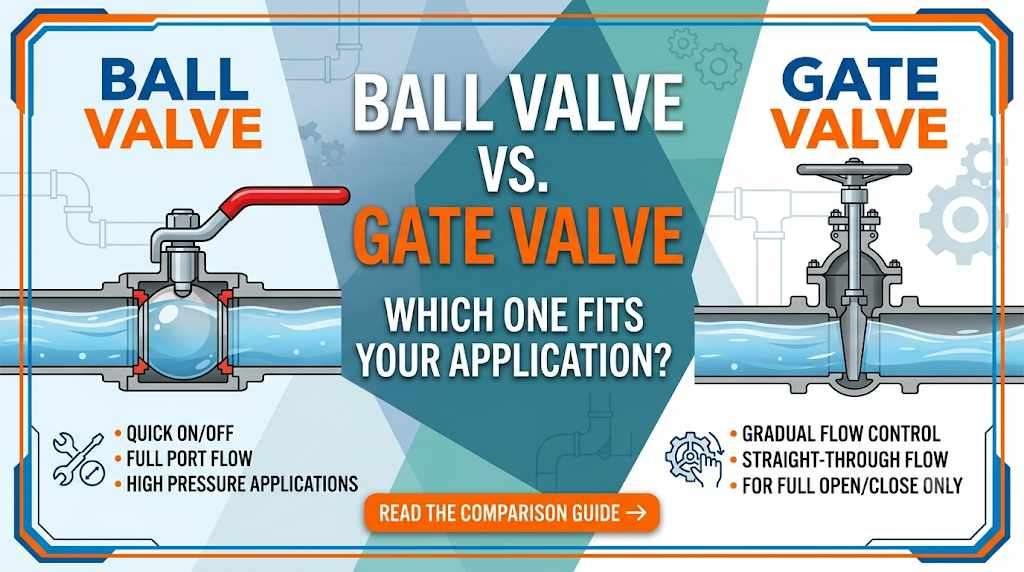
If we look at the mechanism, gate valves have a rotating wheel at the top. Then there is a disk connected to a stem, and a rotating wheel slides the disk (gate) vertically. When an operator rotates the wheel, it raises the disk inside the valve and allows the liquid/gas to pass. When the operator rotates the wheel back into the previous position, its disk comes down to shut down the flow. It takes many rotations to complete the process.
There are different types of gate valves, which are wedge, parallel slide, slab, and knife gate valves. Also, there are rising stem, non-rising stem, screwed bonnet, bolted bonnet, and pressure seal bonnet gate valves. Gate valves offer a two-way flow, which makes them suitable for mixing operations and line isolation operations.
Ball Valves
Ball valves have a different mechanism, which is very simple and takes less effort. All an operator has to do is do a 90-degree rotation of the handle to turn it on. All it takes is a quarter turn, unlike multiple 360-degree turns in gate valves.
There is a hollow ball in ball valves that allows and restricts the liquid or gas. To control that hollow ball, there is a handle that needs just a 90-degree rotation to allow, and then back to the previous position to shut down the flow.
You can call them perpendicular and parallel positions of the valve handle to control the flow. If that handle is perpendicular to the pipe, it means it's shut off. If it is parallel to the pipe, it means it is open.
Trunnion-mounted, three-way, four-way, full-bore, standard bore, V-port, and overflow ball valves are some types of it.
Which Valve Type Provides Faster Control: Ball Valves or Gate Valves?
It all depends on the mechanism of the valve, and ball valves have an advantage over gate valves. They are easy to control when it comes to a faster shutoff mechanism. Here are details that will help you understand better.
Ball Valves
Ball valves have a quick shutoff system, which makes them way more efficient for quick responses. In industries where a fast shutoff system is mandatory, ball valves seem to be a better choice. They have a bubble-tight shutoff system that makes them a safer choice for the oil and gas industry. The same is true for residential and commercial plumbing systems when it comes to gas supply. A fast shutoff system is the core need for maximum safety.
Gate Valves
Gate valves require multiple rotations in the shutoff system, where an operator has to rotate the handles lots of times. That means they have a slow shut-off system because of a large gate and a complex mechanism. Operators have to rotate the handle 360-degrees multiple times to open and close the gate, and it is surely not the right choice for quick shutoff requirements.
Which One Has Less Pressure Drop: Gate Valves or Ball Valves?
The shutoff mechanism also shows the efficiency of valves, where the edge comes to ball valves again. Ball valves are better when it comes to reducing the risk of pressure drop. However, it is better if you look at the comparison in detail.
Ball Valves
The ball valves have a hollow ball inside them that provides large enough room for the liquid and gas to flow. That is why the rate of pressure drop is much lower. If we compare it with gate valves, the pressure drop is less than that of gate valves.
Gate Valves
Even if we look at gate valves, the pressure drop is low. There is minimal flow restriction because of the internal gate mechanism. Compared to ball valves, gate valves are less efficient in the pressure drop factor. You can expect a slightly higher pressure drop in gate valves compared to ball valves.
Are Both the Gate Valve and Ball Valve the Same in Sealing Performance?
No, they are not the same in sealing performance, and there are many factors behind it. The sealing performance of ball valves is much better when used for oil and gas pipelines. The sealing performance is like bubble tight in ball valves compared to gate valves. Here is a detailed explanation in the following comparison.
Ball Valves
If it is for oil and gas, they are the best choice compared to gate valves. They are more compatible for sealing operations in high-pressure applications. Besides, they are not for thick liquids and slurries. There will be poor sealing and more clogging if you use them in slurries and thick liquids. Also, ball valves are not suitable for throttling. Only their V-port type is suitable for it.
Gate Valves
If you compare it with gate valves, they offer less efficient sealing than ball valves. However, gate valves prevent water hammering through their gradual shutoff system. Seats get less wear and tear risk because of this mechanism. Similar to ball valves, gate valves are not suitable for throttling because it will cause too much vibration in the valves. Only the knife gate valve type is the best for thick liquids and slurries.
Which Valve is Cost-Effective, Easily Maintainable, and Less Space-Occupying?
Then we will look at the cost, maintenance, and size factors of both valves. Both have some pros and cons depending on their conditions. If you look at ball valves, they are smaller but costly. Gate valves are larger but cost-effective. Then their maintenance comes, which makes gate valves costly. You will find every factor in detail below in the following comparison.
Ball Valves
Ball valves have compact designs that make them compatible with most piping systems. However, the installation method and the initial price are costlier. If we look at durability, ball valves are more durable and cause fewer challenges in maintenance.
Gate Valves
On the other side, gate valves occupy less space horizontally, but more space vertically. They are usually much larger in size, which is why they are a better choice for large piping systems where a gradual shutoff system is suitable against water hammering. Due to their larger sizes, they occupy more space and are also hard to maintain. Their internal mechanism is complex compared to ball valves.
Their installation cost is lower than that of ball valves, which makes them a cost-effective choice in large structures.
Applications
It is time to know which valve is suitable for which application. Then you will be able to select better because you have already read about their primary operations, pros, and cons. Here are their applications that will make the selection process convenient.
Which Applications Require Ball Valves?
Small and medium structures require ball valves because they occupy less space. They are more efficient in their operations when it comes to quick shutoff systems. If it is about oil and gas operations, ball valves are a better choice.
Plumbing systems in residential and commercial sectors require ball valves. They are better and quicker to respond to fast shutoff requirements. Their sealing performance is also better, which is the utmost requirement in these sectors.
Which Applications Require Gate Valves?
Large pipelines where the risk of water hammering is high require gate valves. Wastewater applications require gate valves for a slow shutoff system against water hammer damage. Also, in projects where low-cost valves are mandatory, gate valves work the best in them.
Conclusion
Ball valves and gate valves are compatible in their specific areas. It will be a big mistake if you choose them with the least knowledge. Their mechanism, cost of installation, maintenance convenience, shutoff system, sealing efficiency, and some other factors will help you decide better. Until you consider those factors, it will be problematic for you to go through the selection process. Hopefully, this guide might have helped you in the selection process.
Recent Post
Leave Your Comments

Zhuhai Kunjian Technology Co.,Ltd

Have a question or need a quote? Fill out this form and our team will get back to you quickly!