


Blogs
The Complete Guide to Choosing Butterfly Valves for Plant Systems
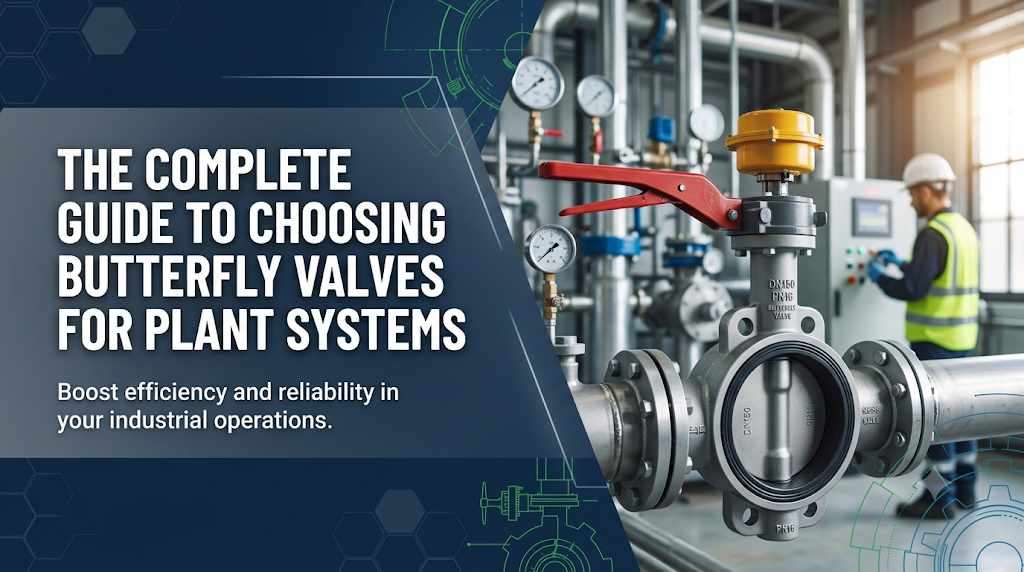
Choosing a butterfly valve can look like a small line item in a plant project but that is completely wrong thinking. A valve that fits the system well can keep the plant operations on schedule, control costs, and reduce operational issues. A poor choice can do the opposite. Leaks, delays, replacement work, safety concerns, all compound to make plant operations slow and full of delays.
In valve selection for a plant you do not need to become a valve specialist to make a sound decision. Instead, you only need to know the right questions to ask early. As a plant manager you already carry enough pressure. You are balancing timelines, budgets, engineering input, supplier promises, and stakeholder expectations so ordering the right equipment at the right time matters. Once equipment is ordered, drawings are approved, and site work begins, changes become expensive. Sometimes very expensive. So the goal is simple: choose a butterfly valve that matches the real working conditions of your plant, not just the lowest price on a quote sheet.
What Is a Butterfly Valve?
A butterfly valve controls the movement of liquid, gas, or other material through a pipe. Inside the valve is a round plate. When the plate turns one way, the pipe opens. When it turns the other way, the pipe closes. It can also sit partly open to control how much material passes through.
Plant systems use butterfly valves because they are compact, fairly light, and often easier to install than some other valve types. They are common in water systems, utility lines, food and beverage plants, chemical processing areas, power facilities, and heating or cooling systems.
Their popularity does not mean one valve fits every job. That assumption causes trouble. The right valve for a clean water line may not suit a hot process line. You need to keep the application scenarios in mind.
Why the Right Valve Choice Matters for a Pipe System
A butterfly valve is a small pipe component having a vastly bigger impact than its size. It can influence installation work, worker access, future servicing, and long-term plant reliability. When a valve is chosen without enough review, the problem may not appear until installation or startup. By then, the project team is already under pressure.
Common issues affect every aspect of performance and range from poor sealing, early wear, and difficult operation to wrong sizing, and materials that do not suit what flows through the pipe. These problems can create rework, extra inspections, delayed commissioning, or emergency replacements after the system goes live.
So yes, the valve is small compared with the whole plant. But its impact can travel far.
Start With the Application
The first question is not “Which valve is cheapest?” It is “What must this valve do every day?”
Some butterfly valves are used mainly to open or close a line. Others are used to control flow more carefully. Some are placed where a section of the system may need to be shut off for repair. Others may be part of a process where a quick response is important.
Next, look at what is moving through the pipe. Is it water, air, gas, steam, a chemical, a thick mixture, or a food-grade product? Is it clean, or does it carry small solids? Is it hot? Is it cold? Could it damage rubber, metal, or coating materials?
These are simple questions, but they prevent costly mistakes. A supplier cannot recommend the right valve if the application is vague. “General plant use” is not enough. It sounds harmless, but it hides risk.
Also confirm how often the valve will operate. A valve opened once a month has a different life than one used every hour. Location matters too. A valve in a dry, indoor utility area faces different conditions from one exposed to weather, washdown, chemicals, or heat.
Know the Main Valve Types
|
Butterfly Valve Type |
Pros |
Cons |
Cost |
|
Basic Rubber-Seated Butterfly Valve |
Good for common plant services. Works well for water, air, and simple utility lines. Easy to find. Often simple to install. |
Not ideal for high heat. May not suit harsh chemicals. Can wear faster in tough service. Not the best choice for critical lines. |
Low to moderate. Usually the most budget-friendly option. |
|
High-Performance Butterfly Valve |
Handles tougher conditions. Offers better sealing. Works better with higher pressure or higher temperature. Can reduce long-term failure risk. |
Costs more than a basic valve. May be more than needed for simple lines. Needs clearer selection details before ordering. |
Moderate to high. Higher upfront cost, but often better value in demanding service. |
|
Triple-Offset Butterfly Valve |
Built for critical service. Strong sealing. Long service life in demanding systems. Good for lines where failure would be costly. |
Highest upfront cost. Needs careful review before purchase. May be too advanced for simple plant duties. |
High. Best suited where reliability matters more than lowest purchase price. |
Match the Valve Materials to the Plant Environment
Material choice is one of the most important parts of valve selection. The valve must stand up to whatever flows through it, as well as the area around it.
Think of the valve as a group of parts working together. The outer body must be strong enough for the line. The round plate inside must resist wear. The sealing surface must stay reliable over time. The turning stem must move smoothly. If one part is poorly matched, the whole valve can become a weak point.
For example, a valve used with clean water may have very different material needs from one used with chemicals. A valve in a food plant may need surfaces that support hygiene requirements. A valve outside near salt air or chemical fumes may need better protection against corrosion.
A good supplier will not be annoyed by these questions. That is often how you can tell who is helping you manage risk and who is only trying to close an order.
Size and Connection: Make Sure It Fits Before It Arrives
A valve can be technically suitable and still cause problems if it does not fit the system layout. This happens more often than it should.
The pipe size must be confirmed. The connection style must match the line. The space around the valve must allow workers to install, operate, and service it. Handles, gear units, or control devices need room to move. Nearby structures, supports, walls, or other equipment can block access.
Before ordering, confirm the pipe size, space around the valve, bolt arrangement, and overall dimensions. Also check whether the valve can be removed later without major disruption. A project team may be focused on installation, but the operations team will live with the decision for years.
A valve that is hard to reach will always result in a maintenance hassle. A valve that cannot be operated safely becomes a safety concern. A valve that requires rework on site becomes a schedule problem. Small checks now prevent big arguments later.
Deciding Between Manual, Gear-Operated, or Automated Options
|
Operation Type |
Pros |
Application Scenario |
|
Manual |
Low cost. Simple to use. Easy to install. Needs little setup. Works well when the valve is easy to reach. |
Use this for small valves. It suits lines that are not adjusted often. It also works when workers can reach the valve safely. |
|
Gear-Operated |
Easier to turn than a basic handle. Gives better control on larger valves. Reduces worker strain. Helps when the valve needs more force to move. |
Use this for medium or large valves. It fits areas where manual turning would be hard or unsafe. It is also useful when smooth, steady control matters. |
|
Automated |
Can open or close without manual effort. Supports remote control. Works well for frequent use. Helps improve speed and consistency. Can support safer operation in hard-to-reach areas. |
Use this when the valve must operate often. It is a strong choice for remote areas, fast shutoff needs, or systems linked to a control room. |
Safety, Compliance, and Plant Standards
Every plant has rules. Some come from law. Some come from industry standards. Others come from the owner’s internal requirements. Valve selection should respect all of them from the beginning.
Project managers should confirm whether the plant requires specific approvals, pressure ratings, material rules, hygiene requirements, fire-safe features, or environmental protections. The exact needs will depend on the plant type and the service involved.
The safest approach is to involve the right internal reviewers early. Engineering, safety, quality, procurement, and operations may each see a different risk. Bring those views together before ordering. It is far easier to resolve a question during selection than after the valve is installed.
Supplier Selection: The Partner Matters
|
Checkpoint |
What to Confirm |
Why It Matters |
|
Plant system experience |
The supplier has worked with plant systems similar to yours. |
A supplier with relevant experience is more likely to understand real site risks, not just catalog details. |
|
Clear application review |
The supplier asks about the material in the pipe, pressure, temperature, location, and how often the valve will operate. |
A good recommendation starts with the real working conditions. Guesswork can lead to delays and early failure. |
|
Plain-language guidance |
The supplier can explain why a valve is suitable without hiding behind technical terms. |
If the reason is not clear, the project team cannot defend the decision later. |
|
Realistic delivery timeline |
The supplier gives a clear lead time and explains any possible delay risks. |
Late valves can hold up installation, testing, and handover. Confirm dates early. |
|
Documentation support |
The supplier can provide product data, material details, test records, installation guidance, and warranty terms. |
Strong documentation helps with review, inspection, and project closeout. |
|
Installation support |
The supplier can answer site questions before and during installation. |
Site teams need fast answers when work is moving. Silence at that stage is expensive. |
|
After-sales support |
The supplier offers help after delivery, including spare parts and service guidance. |
A valve choice should support the plant after startup, not only during procurement. |
|
Similar-use proof |
The supplier can show where the valve has been used in similar conditions. |
Past use does not guarantee success, but it gives the project team more confidence. |
A strong supplier protects more than the purchase. They protect the schedule, the site team, and the plant’s long-term performance. Choose the partner with the same care as the valve itself.
Cost Planning: Look Beyond the Purchase Price
The purchase price is only one part of the cost. A cheaper valve may cost more if it causes installation delays, wears out early, needs frequent servicing, or forces the plant to shut down for replacement.
True cost includes delivery time, installation effort, expected life, spare parts availability, and downtime risk. For non-critical systems, a lower-cost valve may be sensible. For difficult locations or important plant lines, a stronger valve may be the better business decision.
This is where project managers can add real value. You are not just buying equipment. You are protecting the project outcome. When the risk is higher, the selection standard should be higher too.
Common Mistakes to Avoid
One common mistake is choosing by price alone. Price matters, of course. Budgets are real. But a valve that fails early can erase any saving many times over.
Another mistake many inexperienced people make is ignoring what flows through the pipe. The valve must be compatible with the material, temperature, pressure, and operational cycle. Guesswork does not work here so you need to be detail-oriented.
A third mistake is leaving valve selection too late. Late decisions reduce supplier options, increase delivery pressure, and make design changes harder.
A fourth mistake is forgetting access. Someone must be able to operate and service the valve safely. If access is poor, the plant inherits the problem.
The final mistake is accepting unclear recommendations. If the reason for choosing a valve cannot be explained in plain language, the decision needs more review.
Conclusion
The best butterfly valve is not always the most expensive one. It is not always the cheapest one either. The best valve is the one that fits the plant system regardless of the cost. It seamlessly fits the operating conditions, the project schedule, and the level of risk without causing disruption or delay.
The only real way to make the correct choice is to choose early. Ask direct questions. Confirm the real application. Match the valve to the job. Your future site team will thank you, possibly with fewer emergency calls.
Recent Post
Leave Your Comments

Zhuhai Kunjian Technology Co.,Ltd

Have a question or need a quote? Fill out this form and our team will get back to you quickly!