


Blogs
The Ultimate Guide to Industrial Safety Valves
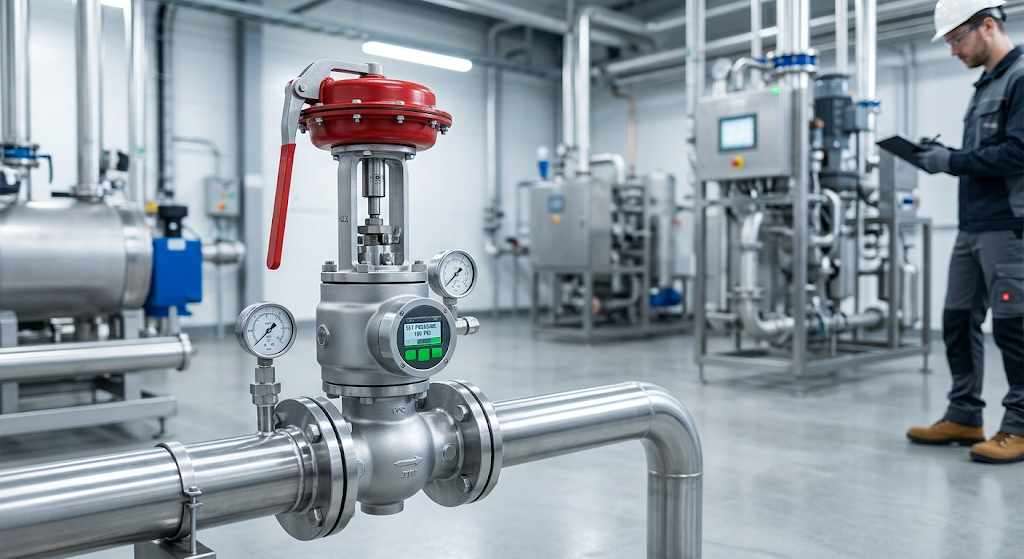
Pressure drives turbines, moves fluids through pipelines, and keeps production lines running. But unmanaged pressure does not stay contained for long.
When a pressurized system exceeds its design limits, the consequences can be severe, equipment failures, unplanned shutdowns, regulatory violations, and in the worst cases, loss of life. The global safety valve market was valued at USD 4.01 billion in 2023 and is projected to reach USD 18.09 billion by 2035, growing at a CAGR of 8.01%. Those numbers reflect how much industry depends on this one small component.
Yet the safety valve remains one of the most misunderstood and poorly maintained components in industrial facilities. Maintenance engineers often wrestle with deteriorating valves that were never correctly sized. Procurement managers source based on price alone, only to find mid-cycle that the specification does not match process conditions.
This guide covers the full scope of industrial safety valves, foundational science, sizing methodology, international standards, and inspection practices.
What Is an Industrial Safety Valve?
A safety valve is a pressure-relief device that automatically releases excess pressure from boilers, pipelines, or pressurized fluid systems. When a specific pressure limit is reached, the disc lifts off the seat, fluid discharges, and the valve re-seats once normal pressure is restored. Without this automatic release, overpressure builds until something else fails, the vessel, the pipe, or the seal.
The terminology here is worth getting straight. In petroleum refining, petrochemical, chemical manufacturing, natural gas processing, and power generation, the term safety valve is often used alongside pressure relief valve (PRV), pressure safety valve (PSV), and simply relief valve. The names get used interchangeably, but they mean different things. A safety valve opens rapidly and handles gas or steam service. A relief valve opens proportionally and handles liquid service. Mixing these up at the specification stage is an expensive mistake.
Key Components of a Safety Valve
- Valve Body and Seat: The structural housing and primary sealing surface; seat integrity determines leak performance.
- Spring Mechanism: A calibrated spring that holds the disc closed until system pressure reaches the set point.
- Disc and Nozzle: The moving element and flow guide that together determine discharge capacity and efficiency.
- Bonnet and Adjusting Screw: Encloses the spring assembly and allows set pressure calibration within a defined range.
- Bellows Assembly: Neutralizes backpressure effects and isolates the spring from corrosive process fluids in critical service applications.
Types of Industrial Safety Valves
Spring-Loaded Safety Valves have the simplest mechanism and are the most widely used. They need no external power or operator intervention, which makes them the default choice for boilers, pipelines, and pressure vessels. Their main limitation is sensitivity to backpressure.
Pilot-Operated Safety Valves use a small pilot valve to control a larger main valve, which gives them accurate set pressure control and low seat leakage. They are well-suited to large pressure vessels and high-pressure petrochemical systems, but their complexity requires a higher level of maintenance competence.
Bellows-Balanced Safety Valves are built for systems where variable backpressure would compromise standard spring-loaded performance. They are typically limited to critical applications in the oil and petrochemical industries. The added cost only makes sense when backpressure variability is an actual design condition.
Pressure and Vacuum Relief Valves provide protection in both directions, releasing overpressure and preventing vacuum formation. Storage tanks and atmospheric vessels need both, since overpressure and vacuum formation each carry structural risk.
Temperature and Pressure Relief Valves (T&P) respond to both temperature and pressure exceedances simultaneously. Hot water systems and steam boilers require both parameters to be monitored, which is why T&P valves are the standard protection device for those applications.
|
Valve Type |
Primary Applications |
Key Advantage |
|
Spring-Loaded |
Boilers, pipelines, pressure vessels |
Simplicity and reliability |
|
Pilot-Operated |
Large vessels, petrochemical, power |
High precision, low seat leakage |
|
Bellows-Balanced |
Oil and petrochemical critical systems |
Stable performance under backpressure |
|
Pressure and Vacuum Relief |
Storage tanks, atmospheric vessels |
Dual-direction protection |
|
T&P Relief |
Hot water systems, steam boilers |
Dual-parameter protection |
Performance Indicators of Industrial Safety Valves
- Set Pressure and Blowdown: Set pressure is the inlet pressure at which the valve opens. Blowdown is the difference between set pressure and re-seating pressure. Too much blowdown wastes process fluid. Too little blowdown causes chatter, which is one of the more damaging operating conditions a safety valve can experience.
- Flow Coefficient and Discharge Capacity: The flow coefficient Kd defines discharge efficiency. Discharge capacity must meet or exceed the maximum credible relief load of the protected system. Undersizing is among the most common and damaging specification errors in pressure system design.
- Seat Tightness: A leaking valve at operating pressure is a compliance failure. API 527 defines the maximum permissible leakage rates. Procurement managers should request seat tightness test certificates as standard acceptance documentation.
- Material Selection: Stainless steel, carbon steel, and specialized alloys resist corrosion, chemical exposure, and temperature extremes. A wrong material specification does not just shorten valve life, it can cause the valve to fail entirely when the system needs it most.
International Standards and Compliance
Compliance is not just paperwork. It is documented proof that a valve has been built and tested to perform under pressure.
ASME Section I and VIII cover fired and unfired pressure vessels, respectively. Section I applies to power boilers operating above 15 psig. Section VIII covers process tanks and piping systems across petrochemical and general industries. Valves certified to these standards carry the UV stamp, which is a baseline requirement for pressure vessel applications.
API 520 and API 526 cover practical sizing and dimensional standards for the oil and gas industry. API 520 provides the orifice area calculation methodology. API 526 ensures dimensional interchangeability between manufacturers, which matters for maintenance teams managing multi-vendor plant pipeline systems.
ISO 4126, DIN, and EN Standards govern safety valve requirements across international and European markets. Procurement managers sourcing valves for cross-border projects need to be familiar with these standards.
CE Marking and PED Compliance are mandatory for any valve supplied into European markets. A CE-marked safety valve shows conformity with the Pressure Equipment Directive. A supplier whose product range lacks CE marking should be treated as a qualification concern.
Safety Valve Sizing and Selection, Getting It Right the First Time
Incorrect Size Dimensions
Incorrect sizing is among the most common and most avoidable safety valve failures in industrial practice. An undersized valve cannot protect the system. An oversized valve leaks and cycles destructively.
The sizing process begins with the maximum credible relief load, the maximum discharge rate required to prevent pressure from exceeding allowable accumulation limits. Set pressure must be at or below the maximum allowable working pressure (MAWP) of the protected equipment. Under ASME Section VIII, allowable overpressure is 10% for a single valve installation.
Wrong Fluid State Assumptions
Fluid medium fundamentally changes the calculation methodology. Gas service uses compressible flow equations. Liquid service uses incompressible flow. Two-phase flow is the most complex and most frequently mishandled scenario in practice. Procurement managers should always request documentation of fluid state assumptions when deciding between a supplier's valve recommendations.
The most common sizing errors are simple but costly, using nominal rather than certified orifice area, ignoring inlet pressure drop, overlooking superimposed backpressure in spring-loaded valve calculations, and failing to re-size after process condition changes. A well-prepared valve data sheet specifying fluid, phase, inlet and outlet conditions, required capacity, set pressure, material requirements, and applicable standards is the most effective validation tool a procurement manager has.
Valve Maintenance, Testing, and Inspection Best Practices
A safety valve that has never been tested is not a safety device. It is an assumption.
Safety valves may go years without opening under normal conditions. That dormancy is deceptive. A corroded seat, a fatigued spring, or a seized disc will not be visible from the outside. Regular testing is the only way to verify that a valve will perform when the system demands it.
In-situ testing verifies set pressure without removing the valve from service. It is faster and less disruptive, which makes it well-suited to routine interval checks. Bench testing, conducted after removal, provides a full evaluation, set pressure verification, seat tightness measurement, blowdown assessment, and disassembly inspection. For critical service valves, bench testing after a fixed period of operation is a regulatory requirement.
Three deterioration symptoms demand immediate attention.
Simmer is audible leakage past the seat at operating pressure. It indicates the valve is running too close to its set pressure or that seat damage has occurred.
Chatter indicates incorrect sizing or excessive inlet pressure drop.
Visible seat leakage is a direct compliance failure requiring immediate corrective action.
Every inspection, test, and corrective action must be documented. In the event of a pressure system incident, the completeness of maintenance records is often the determining factor between demonstrated due diligence and enforcement action.
Delayed maintenance has a measurable cost. An unplanned shutdown triggered by safety valve failure costs several times more than a scheduled inspection would have. The valve that gets maintained on schedule is never the one that appears in the incident report.
Conclusion
The industrial safety valve is the last line of defense between a controlled process and an uncontrolled event.
For maintenance and reliability engineers, test regularly, document thoroughly, and do not defer corrective action. For procurement managers and technical buyers, specify precisely, verify certifications, and choose suppliers whose technical capability matches the criticality of the application.
FAQs
What is the difference between a safety valve and a pressure relief valve?
A safety valve is a rapid-opening device designed primarily for gas and steam service, while a pressure relief valve opens proportionally to overpressure and is typically used for liquid service. Though the terms are often used interchangeably in industry, the distinction matters at the specification stage.
Is ASME certification mandatory for all industrial safety valves?
ASME certification is mandatory for safety valves installed on pressure vessels and boilers governed by ASME codes, which is the case across most of North America and many international projects. Outside these jurisdictions, ISO, EN, or PED compliance may apply depending on the destination market.
What is the purpose of a pressure and vacuum relief valve on a storage tank?
Storage tanks are vulnerable to both overpressure from thermal expansion or filling operations and vacuum formation during emptying or temperature drops. A pressure and vacuum relief valve protects against both conditions simultaneously, preventing structural damage in either direction.
Recent Post
Leave Your Comments

Zhuhai Kunjian Technology Co.,Ltd

Have a question or need a quote? Fill out this form and our team will get back to you quickly!