


Blogs
Swing Check Valve vs. Lift Check Valve: Key Differences Explained
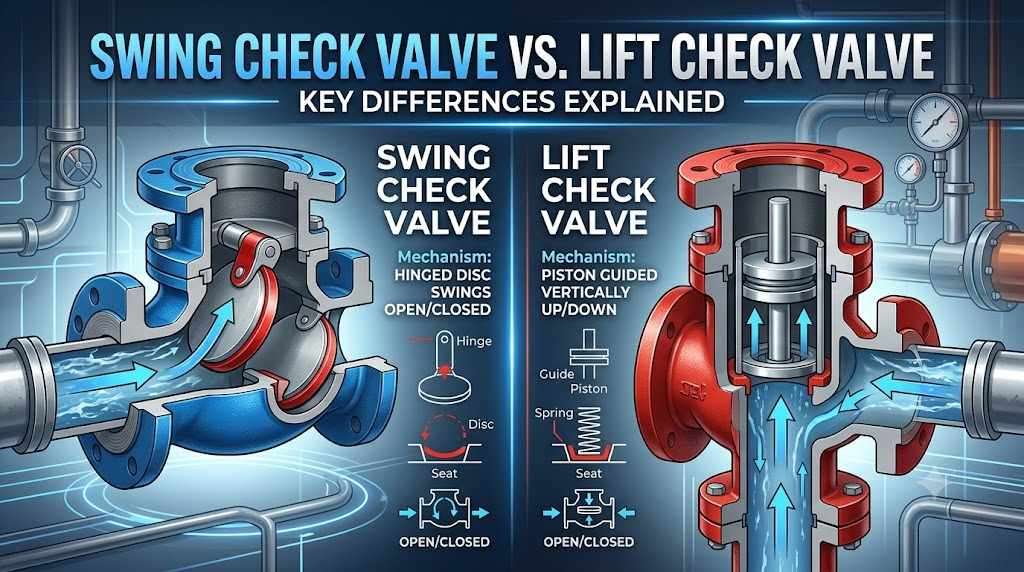
Valve and pipe applications require compatible installation components. If any error takes place in the selection process, the flow efficiency, sealing performance, and lots of factors will be affected. The entire valve system can face problems, which could cause financial loss to firms. Therefore, the supply chain operations have to be cost-effective, and to make them cost-effective, industries choose precise valves. When choosing between swing check valves and lift check valves, you need to have complete information. That information will come from a guide, which is right here. Read this full guide to get answers that will affect your valve system.
Swing Check Valve
Swing check valves are one of the types of check valves. Their size and internal mechanism are different from other types, which also affects their application compatibility. If you are about to choose them for the installation process in the industry, here is what you need to know about them.
What is Swing Check Valve’s Working Mechanism?
The working mechanism seems to be simple if we look in detail. There are two ports, an inlet and an outlet. A hinged disc swings between to close and open the flow. It has a door-like mechanism where the disk swings upward when the flow comes in. This upward movement allows the water to pass through the valve.
The same disk closes as the reverse flow starts. The moment reverse flow starts, the disk automatically moves back to shut the inlet of the valve. Swing check valves can work only in horizontal installation.
What Kind of Flow Path Does a Swing Check Valve Have?
It is compatible only with a unidirectional flow because of its flow path. The internal mechanism is very simple in it because the flow path is linear instead of having any curves, unlike lift check valves. This flow path makes it compatible with wastewater and water treatment operations. Industries need swing check valves for unidirectional flow and large diameters.
How Efficient is Swing Check Valve’s Sealing?
Swing check valves’ sealing is moderate, which is why they are suitable for low-pressure applications. Its sealing is less than that of a lift check valve and not suitable for high-pressure flow. So, in applications where the flow rate is high, and the risk of water hammering is also high, swing check valves can not provide efficient sealing. They can provide good sealing only in low-pressure and larger-volume flow.
How Fast is Swing Check Valve’s Closing Mechanism, and How Much Pressure Drop Does It Face?
The pressure drop rate is low in the swing type. Since they have a linear flow path where the inlet and outlet are on the same scale, the pressure drop is low. This is why, in applications where swing check valves are used, the pressure loss is lower. The simple internal structure provides less obstruction for the liquid to pass through. This is why the shutting mechanism is also swift. The disk gets enough time to swing and shut the flow.
However, there is a risk, and that risk is a water hammer. Swing check valves can face water hammer because the flow path is linear and there is no curve. That means the liquid will not have to change direction a little after entering the valve, and it creates the risk of water hammering.
Where Do Swing Check Valves Work the Best?
Swing check valves work the best in low-pressure and unidirectional-flow applications. They are best compatible with larger diameters of pipes. This is why they are an ideal choice for wastewater and water treatment processes. Their internal mechanism is simple, which makes it suitable for a large flow of liquid with low speed.
Swing check valves are incompatible with applications where reverse flow often occurs. Their simple internal mechanism faces the risk of water hammering, especially where the reverse flow is very frequent.
Lift Check Valve
Then the second type is a lift check valve, where the mechanism inside the valve is completely different. This core difference makes it suitable for some applications and incompatible for some. The flow of liquid and gas can affect the performance of the valve, and this is why you need to know a little about lift check valves.
What is Lift Check Valve’s Working Mechanism?
Let’s start with the internal mechanism, which is complex compared to swing check valves. This complex mechanism causes the water to face a little deviation after it enters from the inlet. The area between the inlet and outlet ports is a little curved, which makes everything different, from function to applications.
In lift check valves, the disk lifts and sits depending on the water flow. When the water enters the valve, the disk lifts to allow it. When the reverse flow occurs, the disk shuts off the flow.
What Kind of Flow Path Does a Lift Check Valve Have?
Lift check valves have a complex flow path, which is because of their S-pattern mechanism inside. The water has to rise up to cross a little curve inside the valve. This curve allows the disk to shut off the flow immediately. These valves also support only unidirectional flow, but they can withstand high-pressure applications.
How Efficient is the Sealing of a Lift Check Valve?
Since lift check valves are suitable for high-pressure flow, they have a better sealing mechanism. The disk moves vertically in these valves to quickly shut and seal the flow. That is why the sealing performance of these valves is better. This sealing efficiency is compatible with applications where the flow volume is medium or low, but the pressure is high.
The area between the inlet and the outlet is complex, which makes it difficult for the disk to fully seal it. The control of the disk on this specific area is much higher, and this is why the sealing efficiency is so good in these valves. They prevent the risk of water hammering. Many applications have a risk of water hammer, and this is where lift check valves work best.
What is Lift Check Valve’s Pressure Drop Rate, and How Efficient is its Shutting Mechanism?
The pressure drop is high in the lift check valve. The reason is the internal mechanism of valves, where the flow path has a complex S-shaped structure. This structure drops pressure higher than in swing check valves. However, the shutting mechanism is fast since the disk has to just sit vertically instead of swinging. It takes less time and has higher sealing efficiency in the shutting mechanism.
Where Do Lift Check Valves Work the Best?
They work best in high-pressure flow. Their internal mechanism has an S-shaped structure that reduces the risk of water hammering. So, if you are willing to choose check valves for quick sealing, especially against water hammering, lift check valves are better.
However, they are compatible with small-diameter pipes where a low volume of flow takes place.
Conclusion
When choosing between swing check valves and lift check valves, you will face lots of confusion. These confusions happen when the information is not enough. You need a guide that can help you make better decisions, and this guide is what you need. If you want check valves for high-pressure flow and medium/small diameter pipes, choose lift check valves. They can prevent water hammering, provide fast shutoff, and provide better sealing. If it is about low-speed and high-volume flow along with large diameter pipes, choose swing check valves.
Recent Post
Leave Your Comments

Zhuhai Kunjian Technology Co.,Ltd

Have a question or need a quote? Fill out this form and our team will get back to you quickly!