


Blogs
Gate Valve vs Ball Valve
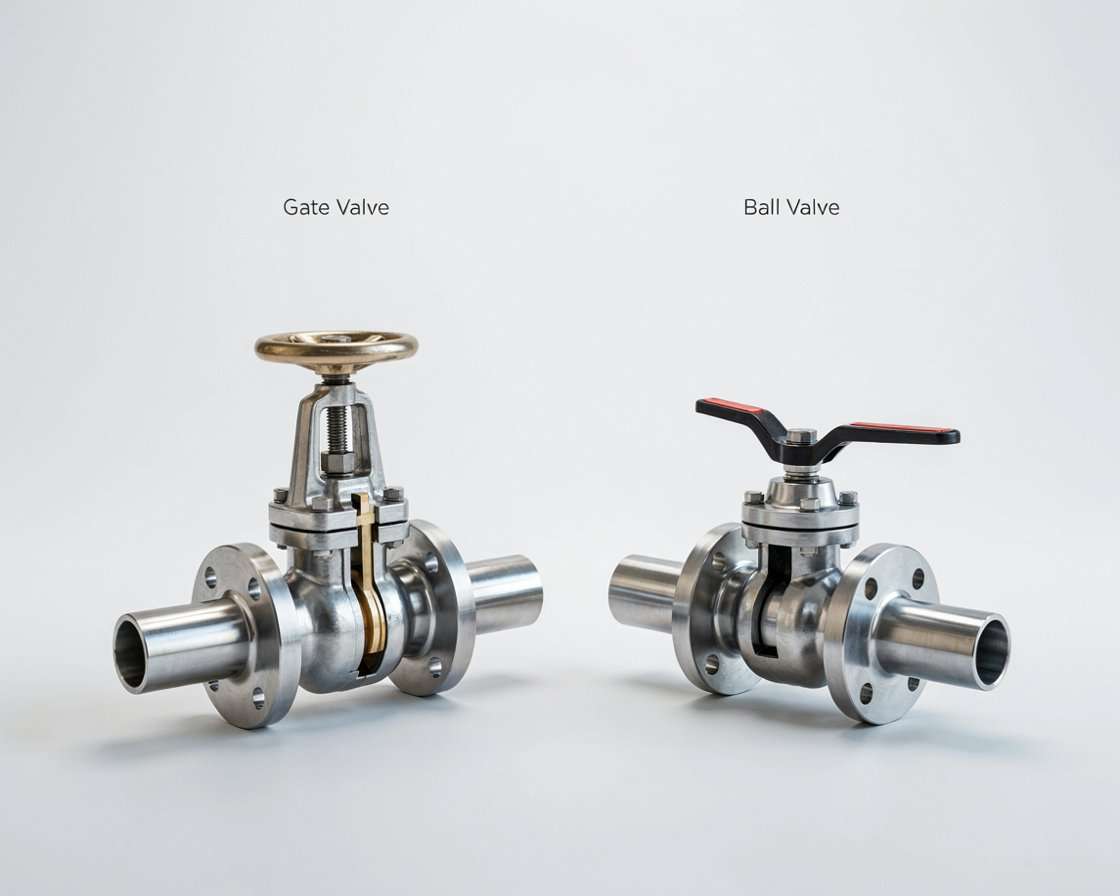
| Gate Valve | Ball Valve | |
|---|---|---|
| Operation | Multi-turn (handwheel raises/lowers a gate) | Quarter-turn (90° rotation) |
| Governing standard | API 600 (steel gate valves) | API 608 (metal ball valves) |
| Shutoff speed | Slow | Fast |
| Best for | Large-diameter, infrequent on/off, full-bore flow | Frequent cycling, tight shutoff, smaller-to-mid diameters |
| Throttling | Not recommended, but tolerated more than a standard ball valve | Not recommended on a standard bore |
| Typical cost driver | Cheaper valve, more long-term maintenance | Higher upfront cost, lower maintenance over time |
How Gate Valves and Ball Valves Work
Gate Valve Mechanism
A gate valve uses a flat or wedge-shaped gate that moves perpendicular to the flow path. Turning the handwheel raises the gate clear of the bore (fully open) or lowers it into the seat (fully closed). API 600, the industry standard for steel gate valves, covers sizes from NPS 2 through NPS 48 and pressure classes 150 through 2500, which explains why gate valves remain the default choice for large-diameter transmission lines.
Because the gate has to travel the full height of the bore, a gate valve typically needs more than one full turn of the handwheel, often several, to go from open to closed. There is no partial-open position that gives predictable flow control: the gate either fully retracts or it doesn't, and resting it partway introduces vibration and accelerated wear on the seat.
Ball Valve Mechanism
A ball valve uses a rotating ball with a bore through its center. A quarter turn of the handle aligns the bore with the pipe (open) or turns it 90° across the flow path (closed). API 608, the standard for metal ball valves, formally defines two bore types: full bore, where the ball's bore matches the connecting pipe's inside diameter, and reduced bore, where the ball's bore is one pipe size smaller. This full bore/reduced bore distinction, not just "ball valve" as a single category, is the detail most comparison articles skip, and it directly affects pressure drop and pigging compatibility.
Full Port vs. Reduced Port — Why Pipe Size Matters
A full-port (full-bore) ball valve has no flow restriction; the open bore is the same diameter as the pipe, so pressure drop across the valve is minimal. A reduced-port ball valve uses a smaller ball to cut material cost and reduce actuator torque, at the expense of a narrower flow path when open.
This matters most in two cases: pipeline pigging, where a full-bore valve is required so the pig can pass through without getting stuck, and viscous or particulate media, where a reduced port increases the risk of clogging and erosion at the constriction point.
Gate valves are inherently full-bore by design, which is one reason they remain common on large water transmission mains and other lines where an unobstructed bore matters more than fast cycling.
Throttling and Flow Regulation: Can You Use Either Valve?
Neither valve type is designed for sustained throttling, but the failure mode differs. A gate valve held partially open exposes the gate edge to high-velocity flow, which erodes the seat and gate over time and can cause vibration-induced damage. A standard ball valve held partially open concentrates flow through a crescent-shaped opening, which accelerates seat wear and can damage the ball's sealing surface.
If your application genuinely requires modulating flow rather than simple on/off control, the better options are a globe valve, a needle valve for small-diameter precision control, or a V-port ball valve, which uses a specially profiled ball designed for controlled flow characteristics rather than tight shutoff. Specifying a standard gate or ball valve for throttling duty is a common and avoidable design mistake.
Water Hammer Risk and How to Avoid It
Water hammer is a pressure surge caused by a sudden change in fluid velocity, most commonly from closing a valve too quickly in a line carrying moving liquid at pressure. Because a ball valve can close in a quarter turn, it is far more likely than a gate valve to trigger water hammer if closed rapidly, and in high-pressure lines the resulting pressure spike can be enough to damage pipe joints or fittings.
The practical mitigation is procedural, not just a valve choice: on manually operated ball valves in pressurized lines, close the handle slowly rather than snapping it shut. On automated systems, this is addressed by specifying an actuator with a controlled closing speed rather than assuming the valve itself will protect the system. A gate valve's inherently slow, multi-turn closure gives it a natural, if incidental, advantage here.
Cost, Maintenance, and Automation
Upfront, gate valves are generally the cheaper purchase. Their disadvantage shows up over the service life: the sliding gate and threaded stem are wear points, and in corrosive or particulate-heavy media, stem binding and seat wear lead to more frequent maintenance or replacement.
Ball valves cost more initially but have fewer moving parts in continuous contact under load, and three-piece ball valve bodies allow the seats and seals to be serviced without removing the valve from the pipeline entirely, unlike a two-piece or one-piece body.
Automation cost is a genuine, frequently overlooked factor: a quarter-turn actuator for a ball valve is mechanically simpler and generally less expensive than a multi-turn actuator capable of driving a gate valve's stem through several full rotations. On projects where many valves will be automated, this difference compounds across the whole valve schedule, not just the price of a single unit.
Applications: Where Each Valve Type Is Actually Used
Gate valves dominate large water transmission and distribution mains, power plant cooling water systems, and mining and process plant isolation duty, anywhere a full, unobstructed bore and infrequent operation matter more than cycle speed.
Ball valves are the standard choice for oil and gas shutoff, compressed air and gas systems, and any service needing frequent, reliable on/off cycling.
Food, beverage, and pharmaceutical service is where a standard ball valve is genuinely the wrong choice, and this is a real, resolvable distinction rather than a coin toss. A standard ball valve has a dead-space cavity between the ball and the body seat where product residue can collect and support bacterial growth, which is why it's generally avoided in hygienic service. Sanitary (hygienic) ball valves solve this with a cavity-filled or fully encapsulated PTFE seat design that eliminates that trapped space, and many are built with tri-clamp connections for tool-free disassembly and cleaning. If you see "ball valve" recommended for food or pharmaceutical lines, confirm it is specifically a sanitary-rated design, not a standard industrial ball valve, before specifying it.
Materials and Construction Options
Both valve types are commonly available in brass, bronze, carbon steel, and stainless steel, selected based on media compatibility, pressure, and corrosion resistance rather than valve type alone.
Ball valve bodies come in one-piece, two-piece, and three-piece configurations. A three-piece body can be disassembled at the end connections without removing the entire valve from the pipeline, which significantly reduces maintenance downtime, at a higher unit cost than a welded one-piece body.
Gate valves are specified with either a rising stem, where the stem visibly moves up as the valve opens, giving a clear visual indication of valve position, or a non-rising stem, used where vertical clearance is limited and the stem threads instead move internally within the bonnet.
Gate Valve vs. Ball Valve: Full Comparison Table
| Factor | Gate Valve | Ball Valve |
|---|---|---|
| Operation | Multi-turn, slow | Quarter-turn, fast |
| Bore | Full bore by design | Full bore or reduced bore (API 608) |
| Governing standard | API 600 | API 608 |
| Throttling suitability | Poor; use for isolation only | Poor on standard bore; use V-port for control |
| Water hammer risk | Low, due to slow closure | Higher if closed quickly |
| Typical size range in service | Larger diameters common | Wide range, common in smaller-to-mid diameters |
| Upfront cost | Lower | Higher |
| Long-term maintenance | Higher (stem, seat wear) | Lower, especially 3-piece design |
| Automation cost | Higher (multi-turn actuator) | Lower (quarter-turn actuator) |
| Hygienic/food service | Not typically used | Only sanitary-rated (cavity-filled) designs |
| Visual position indication | Yes, with rising stem | Yes, via handle orientation |
FAQs
Are ball valves safe for food and beverage lines?
Only if they are specifically built as sanitary (hygienic) ball valves with a cavity-filled or fully encapsulated seat. A standard industrial ball valve has a dead space between the ball and body where product can collect, which is a contamination risk in food, beverage, and pharmaceutical service.
What pipe size should use a gate valve vs. a ball valve?
There's no strict cutoff, but gate valves dominate larger transmission and distribution lines where a full, unobstructed bore matters, while ball valves are more common from small-bore instrumentation lines up through mid-size process piping where frequent cycling is needed.
Can a ball valve be used for throttling?
Not a standard ball valve; partial opening accelerates seat and ball wear. A V-port ball valve is purpose-built for flow control if throttling is genuinely required.
Which valve is cheaper to automate?
Ball valves, generally. Their quarter-turn action needs only a simple rotary actuator, while a gate valve's multi-turn stem requires a larger, more expensive actuator to drive it through several full rotations.
Final Recommendation
Choose a gate valve when you need a full, unrestricted bore, infrequent operation, and lower upfront cost, and you can accept slower shutoff and higher long-term maintenance. Choose a ball valve when you need fast, reliable, frequent shutoff with lower maintenance over the valve's life, and confirm full-bore vs. reduced-bore, sanitary rating, and closing speed against your specific application before finalizing the specification, since none of these factors are safely assumed from the valve type alone.
Recent Post
Leave Your Comments

Zhuhai Kunjian Technology Co.,Ltd

Have a question or need a quote? Fill out this form and our team will get back to you quickly!