


Blogs
Butterfly Valve vs Gate Valve
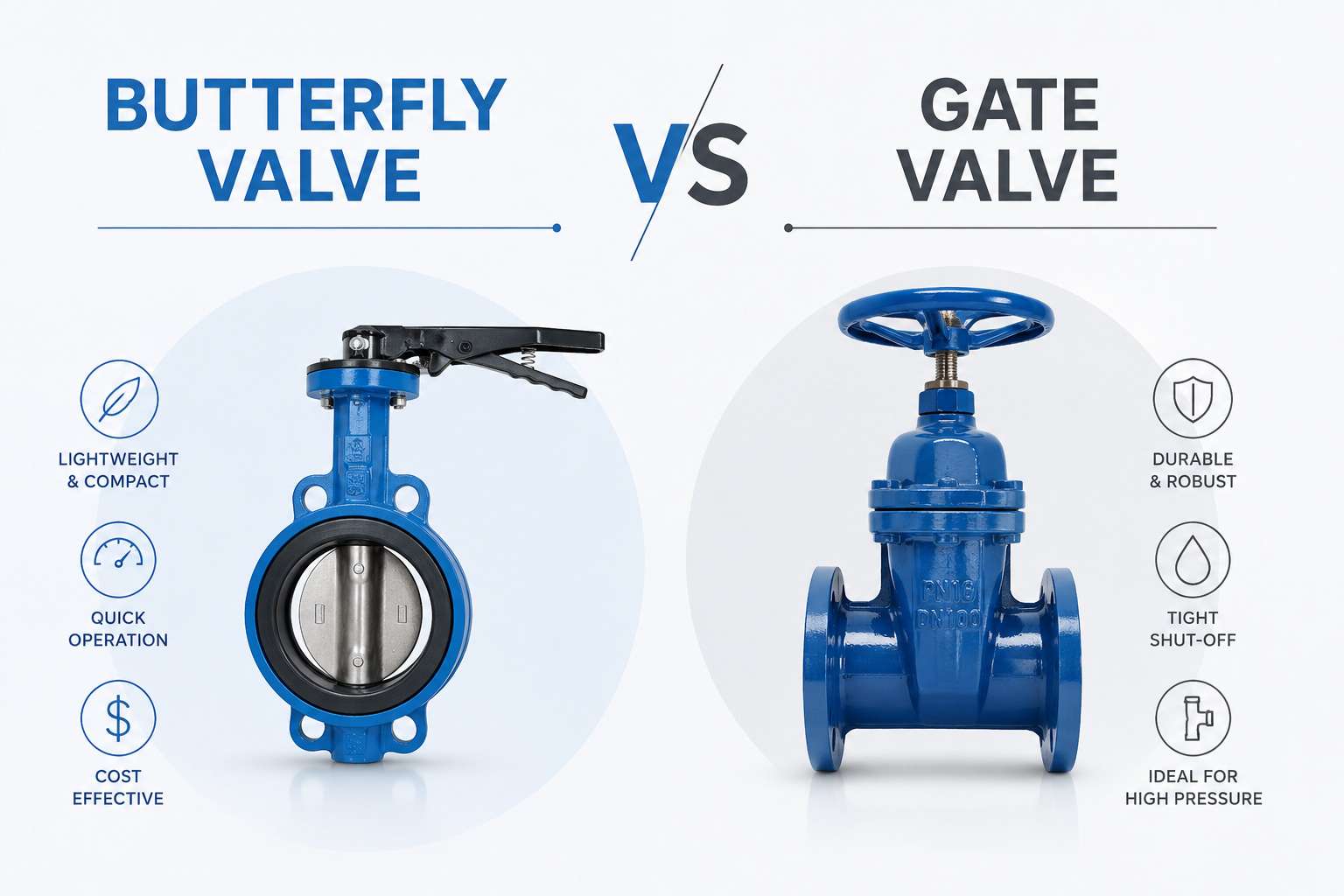
Choosing between a butterfly valve and a gate valve is not simply a matter of comparing price or valve size. The correct choice depends on the pipe diameter, pressure and temperature, fluid, required flow path, operating frequency, shutoff requirements, installation space, and whether the pipeline needs cleaning or pigging.
The main design difference is simple: a butterfly valve uses a rotating disc that remains in the flow passage when fully open, while a gate valve lifts its gate out of the flow path. This difference affects pressure drop, weight, operating speed, installation space, and application suitability.
For large-diameter systems where compactness and fast operation matter, a butterfly valve can be attractive. Where full-bore flow, very low flow resistance, or pigging is important, a gate valve may be more suitable.
The final selection should always be based on the valve's actual pressure-temperature rating, materials, seat design, applicable standards, and project specifications.
How Does a Gate Valve Work?
A gate valve uses a gate or wedge that moves perpendicular to the flow path. Turning the stem raises the gate to open the valve and lowers it against the seats to close the valve.
When the gate is fully open, it moves clear of the main flow passage. This creates a relatively unobstructed path for the fluid.
Gate valves are therefore primarily used for on/off isolation, rather than continuous flow regulation. Keeping a standard gate valve partially open can expose the gate and seating surfaces to high-velocity flow. Over time, this can contribute to erosion, vibration, and seat damage.
Gate valves are available in several configurations, including wedge, parallel-slide, rising-stem, and non-rising-stem designs. The appropriate configuration depends on the pressure, temperature, medium, installation conditions, and project requirements.
For buyers sourcing industrial gate valves, the gate valve range provides a starting point for comparing available valve options.
How Does a Butterfly Valve Work?
A butterfly valve uses a circular disc mounted on a shaft. The disc rotates approximately 90 degrees between the open and closed positions.
When the valve is open, the disc remains inside the pipeline. It does not retract completely from the flow passage.
This creates the fundamental trade-off of the design:
- The valve can be compact and lightweight.
- It requires only quarter-turn operation.
- It can be well suited to large-diameter pipelines.
- But the disc creates some obstruction in the flow path.
Butterfly valves are available in different designs, including concentric and offset configurations. Seat materials can also vary, which affects temperature capability, chemical compatibility, sealing behavior, and service life.
See the butterfly valve range when comparing industrial butterfly valve configurations.
Butterfly Valve vs Gate Valve: The Fundamental Difference
The easiest way to understand the comparison is to look at what happens inside the pipe when each valve is fully open.
| Factor | Gate Valve | Butterfly Valve |
|---|---|---|
| Closing element | Gate or wedge | Rotating disc |
| Motion | Linear | Quarter-turn rotary |
| Fully open flow path | Gate retracts from the passage | Disc remains in the passage |
| Flow resistance | Typically very low when fully open | Some restriction remains |
| Operating speed | Generally slower | Generally faster |
| Weight at large diameters | Generally higher | Generally lower |
| Installation space | More vertical clearance often required | Compact |
| Throttling | Generally unsuitable for sustained throttling | Possible with suitable design and service |
| Large-diameter applications | Suitable, but can become heavy | Often attractive |
| Pigging | Full-bore designs can support pigging | Conventional designs obstruct pig passage |
Neither valve is universally better. The correct question is: which design matches the operating conditions of the system?
Pressure Drop and Flow Resistance
Pressure drop is an important consideration when selecting a valve for a pumped or high-flow system.
A fully open gate valve provides a relatively unobstructed flow path because the gate is removed from the main passage. This makes gate valves useful where minimizing flow resistance is important.
A butterfly valve retains its disc in the flow stream. The resulting restriction depends on the valve's geometry, size, disc profile, operating position, and flow conditions.
The difference may be acceptable in many water, HVAC, and utility systems. However, it becomes more important when a system has high flow rates or when pumping energy is a major operating cost.
Do not assume that one valve will always produce a specific pressure loss. For engineering selection, compare the manufacturer's flow coefficient or pressure-drop data at the actual flow rate.
Throttling and Flow Control
One of the most common mistakes in valve selection is treating isolation valves as general-purpose control valves.
Gate valves and throttling
Standard gate valves are normally intended for fully open or fully closed service.
When a gate is held partially open, fluid passes through a restricted opening. High local velocity can affect the gate and seats, increasing erosion and vibration. For continuous or precise modulation, a purpose-designed control valve is usually more appropriate.
Butterfly valves and throttling
A butterfly valve can provide flow regulation when its design and service conditions allow it. However, that does not mean every butterfly valve is suitable for continuous throttling.
The valve design matters.
A basic concentric butterfly valve may be appropriate for many utility and general industrial duties. Double-offset and triple-offset designs use different disc and seat geometries and can be selected for more demanding services.
For sustained modulation, check the manufacturer's allowable operating range, pressure differential, cavitation limits, seat material, and flow characteristics before specifying the valve.
Concentric, Double-Offset, and Triple-Offset Butterfly Valves
Not every butterfly valve should be treated as the same product.
Concentric butterfly valves
The shaft and disc arrangement is centered around the valve body and seat. These valves are widely used for general isolation and utility applications.
Resilient seats can provide effective shutoff, but the elastomer limits the temperature and chemical-service envelope.
Double-offset butterfly valves
The shaft is offset from the centerline and seat. This reduces rubbing between the disc and seat during operation and can improve performance in more demanding services.
Triple-offset butterfly valves
A third offset creates a cam-like seating action. These valves commonly use metal seating and are designed for demanding pressure and temperature conditions where a resilient-seat design may not be suitable.
Therefore, saying simply that “butterfly valves are low-pressure valves” is too broad. The actual pressure-temperature capability depends on the valve category, construction, materials, seat arrangement, and applicable standard.
Sealing Performance: Look Beyond the Valve Type
Both butterfly and gate valves can provide effective shutoff, but sealing performance depends on the actual design.
Important variables include:
- Seat material
- Seat geometry
- Disc or gate design
- Pressure differential
- Temperature
- Fluid compatibility
- Manufacturing tolerances
- Required leakage acceptance criteria
- Valve testing requirements
Resilient-seated butterfly valves can provide very tight shutoff in suitable services. Metal-seated butterfly valves are used where higher temperature or more demanding service conditions require a different sealing approach.
Gate valves may use resilient or metal seating depending on the design and application.
What about leakage classes?
Leakage classifications should not be treated as universal characteristics of an entire valve family.
For procurement, the buyer should specify the required leakage performance and the applicable test standard rather than assuming that every butterfly valve or gate valve meets a particular class.
This is especially important for critical isolation. Ask the manufacturer for the relevant test documentation and acceptance criteria.
Pressure and Temperature: Don't Choose by Valve Type Alone
Pressure class and temperature capability are among the most important selection criteria.
A common mistake is to say that gate valves are always suitable for high pressure while butterfly valves are limited to low pressure. The real answer depends on the design.
API 609 covers several butterfly valve configurations and pressure-temperature requirements, including Class 150, Class 300, and Class 600 configurations for specified designs and sizes. API 600 covers steel gate valves, while API 6D covers pipeline and piping valves and includes gate valves used in applicable pipeline service.
ASME B16.34 also provides pressure-temperature ratings and other requirements for applicable valve construction.
The practical lesson is simple:
Select the pressure class from the actual operating pressure and temperature, not from the valve name alone.
Size, Weight, and Installation Space
Size can significantly affect the economics of valve selection.
As valve diameter increases, the weight and physical dimensions of a gate valve can become substantial. Large gate valves also require vertical clearance for the stem and gate movement.
Butterfly valves generally have a compact body and short face-to-face dimensions. This can reduce handling and installation challenges, particularly in large-diameter piping systems.
However, there is no universal diameter at which a butterfly valve automatically becomes cheaper than a gate valve.
The actual cost depends on:
- Valve diameter
- Pressure class
- Body material
- Seat material
- Valve configuration
- End connection
- Actuator
- Quantity
- Project specifications
- Installation requirements
For this reason, avoid using a fixed rule such as “butterfly valves are always cheaper above DN300.” Compare the complete installed solution instead.
Installation and Actuation
The operating mechanism creates another major difference.
A gate valve uses linear movement and normally requires multiple turns to travel from fully open to fully closed.
A butterfly valve requires approximately a quarter turn. This makes it convenient for manual gear operation and quarter-turn automation.
For projects with many automated valves, actuator selection can become an important part of total project cost.
Butterfly valves can use lever, gear, pneumatic, or electric operation depending on the design and requirements. Gate valves can also be automated, but their multi-turn operation requires a suitable actuator arrangement.
Installation space also matters. A butterfly valve's compact body can be useful where valve chambers, equipment layouts, or pipe racks have limited space.
Pigging and Pipeline Cleaning
Pigging can be a decisive factor in the Butterfly Valve vs Gate Valve decision.
Pipeline pigs travel through the internal bore to perform tasks such as cleaning, inspection, product separation, or maintenance.
A full-bore gate valve can be compatible with pigging when its internal geometry and installation meet the requirements of the pipeline and pig design. When fully open, the gate retracts from the main passage.
A conventional butterfly valve presents a different problem. Its disc remains in the flow path even when fully open. That disc can obstruct a conventional pipeline pig.
Therefore, if routine pigging is a project requirement, the valve must be selected with the complete pipeline geometry in mind.
Do not simply specify a valve as “piggable” without confirming the internal dimensions and pig requirements with the valve and pipeline designers.
Water Hammer and Closing Speed
Valve closing speed can affect transient pressure in liquid systems.
Water hammer occurs when a change in fluid velocity creates a pressure surge. Rapid valve closure can increase the severity of the transient.
A butterfly valve can close through a quarter-turn, so automated systems need appropriate control of closing speed where transient pressure is a concern.
A gate valve's multi-turn operation naturally takes longer to close. This can reduce the likelihood of abrupt velocity changes, although water hammer depends on the complete hydraulic system, including pipe length, fluid velocity, pressure, valve closure time, and other system characteristics.
The right approach is not simply to choose a gate valve because it closes slowly. Where water hammer is a concern, perform or review the system's transient analysis and specify the valve and actuator accordingly.
Maintenance Considerations
Maintenance requirements depend heavily on valve design and service conditions.
Gate valve maintenance
Potential maintenance concerns include:
- Stem and packing wear
- Seat wear
- Gate or wedge damage
- Corrosion
- Deposits or solids affecting seating
- Difficult operation after long periods without cycling
Gate valves that remain unused for long periods may require attention before operation, especially in harsh environments.
Butterfly valve maintenance
Common considerations include:
- Seat wear
- Shaft and seal condition
- Disc damage
- Elastomer compatibility
- Actuator and gearbox maintenance
- Corrosion or deposits around the disc
Resilient-seat butterfly valves can be relatively simple to operate and maintain, but the seat material must be compatible with the actual fluid and temperature.
The maintenance decision should therefore consider service conditions rather than assuming one valve type always has lower maintenance costs.
Butterfly Valve vs Gate Valve: Cost and Lifecycle Value
Initial purchase price is only one part of B2B valve cost.
A proper comparison should consider:
Purchase cost → installation → actuation → energy impact → maintenance → downtime → replacement
Butterfly valves can offer economic advantages where their lower weight, compact construction, and shorter installation dimensions reduce project costs. These advantages can become more relevant as pipe diameter increases.
Gate valves can justify their cost where full-bore flow, low flow resistance, pipeline isolation, or pigging requirements are more important.
Energy cost also depends on the actual pressure drop across the selected valve and the operating profile of the system. A valve that costs less to purchase may not produce the lowest lifecycle cost if it creates additional pressure loss over many operating hours.
For a meaningful lifecycle comparison, use actual flow, pressure-drop, operating-hour, energy-price, maintenance, and replacement data.
Butterfly Valve vs Gate Valve by Application
Water Treatment and Municipal Water
Butterfly valves are commonly considered for large water pipelines because their compact design, lower weight, and quarter-turn operation can simplify installation and operation.
AWWA C504 specifically covers rubber-seated butterfly valves for waterworks applications.
Gate valves are also widely used in water systems. AWWA C500 covers metal-seated gate valves for water supply service.
The correct choice depends on pressure, diameter, operating frequency, space, shutoff requirements, and project standards.
HVAC
Butterfly valves are often practical in larger HVAC and utility piping where compact dimensions, quick operation, and economical installation are important.
The actual seat and body materials should be checked against the fluid, temperature, pressure, and system requirements.
Oil and Gas
Gate valves remain important in pipeline and process isolation applications where full-bore passage, pressure requirements, or pigging can be decisive.
However, butterfly valves also have an important role in oil and gas facilities, particularly where suitable high-performance designs meet the project's pressure, temperature, sealing, fire-safe, and material requirements.
Do not select the valve based on industry name alone. Review the project specification and applicable standards.
Power Generation
Both valve types can be used in power and utility systems, but service conditions vary widely.
Cooling water may favor a different design from high-temperature steam or fuel service. Pressure, temperature, fluid chemistry, shutoff requirements, and applicable codes should drive the selection.
Slurry and Solids-Containing Service
Slurry requires special attention because abrasive particles can damage seats and internal surfaces.
A standard butterfly valve or standard wedge gate valve should not automatically be selected simply because it is described as suitable for “industrial service.”
Depending on solids concentration, particle size, pressure, abrasion level, and flow requirements, a knife gate or specialized slurry valve may be more appropriate.
For these services, evaluate the actual medium and wear mechanism before choosing the valve type.
Standards for Butterfly and Gate Valves
Applicable standards depend on valve construction and application.
| Valve/Application | Relevant Standard |
|---|---|
| Butterfly valves | API 609 |
| Rubber-seated waterworks butterfly valves | AWWA C504 |
| Steel gate valves | API 600 |
| Small-size petroleum/natural gas gate valves | API 602 |
| Corrosion-resistant gate valves | API 603 |
| Pipeline and piping valves | API 6D |
| General pressure-temperature valve requirements | ASME B16.34 |
| Valve face-to-face dimensions | ASME B16.10 |
| Metal-seated waterworks gate valves | AWWA C500 |
Standards should not be treated as interchangeable certifications. The applicable document depends on the valve type, construction, service, size, rating, and project specification.
How to Choose Between a Butterfly Valve and Gate Valve
Use this seven-step framework before requesting a quotation.
1. Identify the fluid
Define whether the valve will handle:
- Water
- Gas
- Oil
- Steam
- Chemicals
- Wastewater
- Slurry
- Other process fluids
Check compatibility with the body, seat, disc, gate, stem, and seals.
2. Confirm pressure and temperature
Specify:
- Normal operating pressure
- Maximum operating pressure
- Minimum and maximum temperature
- Design pressure
- Design temperature
Then select the appropriate pressure-temperature rating.
3. Determine the required flow path
Ask whether the system needs:
- Very low pressure loss
- Full-bore passage
- Pigging
- Minimum obstruction
- Standard utility flow
If full-bore passage is critical, a gate valve may have an important advantage.
4. Determine operating frequency
For valves that cycle frequently, quarter-turn operation can be valuable.
For valves that remain open or closed for long periods, the priority may instead be reliable isolation and compatibility with the operating conditions.
5. Check the installation space
Measure:
- Face-to-face space
- Vertical clearance
- Access for maintenance
- Actuator clearance
- Pipe support requirements
A compact butterfly valve can be advantageous where space or handling capacity is limited.
6. Define the shutoff requirement
Do not simply request “tight shutoff.”
Specify the required leakage performance, test procedure, direction of pressure, temperature, and service conditions.
7. Check applicable standards
Confirm whether the project requires API, ASME, AWWA, EN, or another standard.
The purchase specification should also identify valve size, pressure class, body and trim materials, end connections, operator type, and any special testing or documentation requirements.
What Should You Specify When Buying a Butterfly or Gate Valve?
A professional valve inquiry should contain enough information for the supplier to select the correct configuration.
At minimum, provide:
- Valve type
- Nominal size
- Pressure class or PN rating
- Operating pressure
- Design pressure
- Operating temperature
- Design temperature
- Fluid or medium
- Flow rate
- Valve function
- Required shutoff performance
- Body and trim material requirements
- Seat material requirements
- End connection
- Manual or automated operation
- Applicable standard
- Inspection and testing requirements
- Pigging requirements, if applicable
- Quantity
- Project-specific approvals or documentation
The more complete the valve specification, the lower the risk of comparing unsuitable products on price alone.
Frequently Asked Questions
Can a butterfly valve replace a gate valve?
Sometimes, but not automatically.
A butterfly valve may be suitable where compactness, lower weight, quick operation, or large-diameter installation is important. A gate valve may be more suitable where full-bore flow, very low pressure loss, or pigging is required.
The pressure, temperature, fluid, sealing requirements, and project standards must also be checked.
Which has lower pressure drop, a butterfly valve or gate valve?
A fully open gate valve generally provides lower flow resistance because the gate retracts from the main flow path.
A butterfly valve retains its disc in the flow passage, so some additional restriction is normally present.
The actual pressure drop should be checked using the manufacturer's flow data at the required flow rate.
Can butterfly valves be used for throttling?
Some can, but the valve design and service conditions matter.
Butterfly valves can provide flow regulation, but a standard isolation butterfly valve should not automatically be treated as a precision control valve. Check the manufacturer's operating limits, pressure differential, flow characteristics, and seat requirements.
Which valve is better for large-diameter pipes?
There is no universal winner.
Butterfly valves often become attractive at larger diameters because of their compact design and lower weight. Gate valves can remain preferable where full-bore passage, low pressure loss, or pigging is important.
Are butterfly valves suitable for high-pressure applications?
Some are.
High-performance and offset butterfly designs can be engineered for demanding pressure and temperature conditions. However, pressure capability depends on the specific design, materials, pressure class, temperature, seat arrangement, and applicable standard.
Are butterfly valves piggable?
Conventional butterfly valves are generally unsuitable for conventional pipeline pigging because the disc remains in the flow passage.
If pigging is required, verify the complete valve and pipeline configuration before specification.
Which valve provides tighter shutoff?
Neither valve type can be declared universally tighter.
Shutoff depends on the valve design, seat material, pressure differential, temperature, manufacturing quality, and specified leakage requirement.
Always check the manufacturer's documented test results and acceptance criteria.
What is the main advantage of a gate valve?
The main advantage is its relatively unobstructed flow path when fully open.
This can make gate valves useful where low pressure loss, full-bore flow, isolation, or pipeline pigging is important.
What is the main advantage of a butterfly valve?
Its compact quarter-turn design makes it attractive where low weight, limited installation space, fast operation, and large-diameter service are important.
Final Takeaway
The choice between a butterfly valve and a gate valve should start with the service conditions, not the valve price.
Choose a gate valve when the application places high importance on a relatively unobstructed flow path, low pressure loss, full-bore service, or pipeline pigging.
Consider a butterfly valve when compact construction, lower weight, short installation dimensions, and quarter-turn operation provide practical advantages.
For demanding industrial applications, go one step further. Check the pressure-temperature rating, seat and material compatibility, leakage requirements, operating frequency, actuator, applicable standards, and pipeline requirements before making the final selection.
If neither valve meets the application's requirements, other valve technologies may be more appropriate. For example, buyers can compare industrial ball valves where fast quarter-turn isolation or different pressure and sealing characteristics are required. For related selection guidance, see the Gate Valve vs Ball Valve comparison.
For systems that also require reverse-flow protection, a suitable check valve can be evaluated separately rather than treating it as a substitute for an isolation valve.
For a specific gate-valve requirement, buyers can also review the Cast Steel ANSI Gate Valve and confirm its specifications against their project requirement
Recent Post
Leave Your Comments

Zhuhai Kunjian Technology Co.,Ltd

Have a question or need a quote? Fill out this form and our team will get back to you quickly!