


Blogs
How to Compare Check Valve Manufacturers and Suppliers
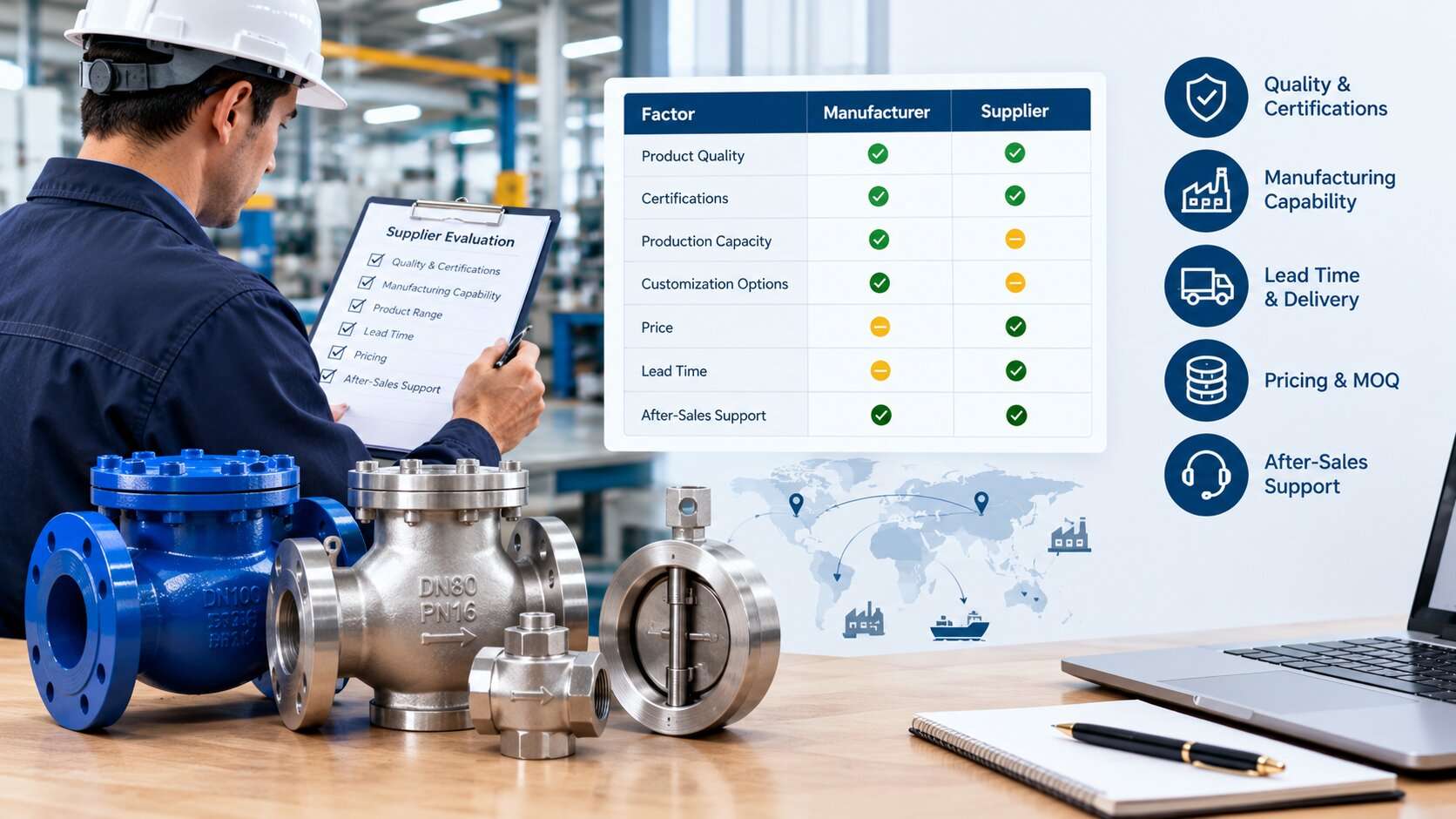
Two check valve quotes can look identical on paper and behave very differently in the pipe. The datasheet lists a size, a pressure class and a material. It rarely shows who cast the body, which tests the valve actually passed, or what happens when a spring wears out in year three.
Comparing check valve manufacturers and suppliers well means comparing evidence, not catalogs. This guide gives you a method. Decide whether you need a manufacturer or a supplier. Fix your own specification. Score every candidate against the same weighted criteria. Then verify the claims that carry the most risk.
Quick answer: six steps
- Decide which supplier type fits the purchase.
- Write the specification before you request quotes.
- Score each candidate on the same weighted scorecard.
- Verify certificates and test records at the source.
- Compare total cost, not unit price.
- Validate with a sample or inspection before volume.
Manufacturer or supplier? Decide this first
“Supplier” covers very different businesses. They carry different risks, so decide which type you need before you compare anything else.
| Type | What it does | Strongest at | Main risk |
|---|---|---|---|
| Manufacturer with own foundry and machining | Casts, machines, assembles and tests valves | Custom specs, traceability, design data, direct warranty | Longer lead times on non-standard items |
| Manufacturer that assembles bought-in castings | Machines and assembles, but buys castings | Competitive price, standard ranges | Traceability depends on the casting source |
| Authorized distributor or stockist | Holds inventory from one or more makers | Fast delivery, small quantities, local returns | Limited customization; warranty depends on the maker |
| Trading company or agent | Sources to order | Product range, buying convenience | Weakest accountability for quality and records |
Prioritize a manufacturer when:
- The specification is non-standard: unusual sizes, materials, end connections or leakage requirements.
- The project needs a full document package, heat-number traceability or witnessed testing.
- Volume is large enough to justify supplier qualification.
- You need design data, such as closing behaviour or head loss at your duty point.
- You want a single party responsible for failure analysis.
Prioritize a supplier when:
- The need is urgent, such as a plant shutdown or a replacement for an installed valve.
- Quantities are small and sizes are standard.
- You need local stock, local returns and fast technical contact.
- The order is a mixed basket and one account is easier to manage.
The hybrid case matters most. Many distributors sell manufacturer-backed product. Ask for the original manufacturer’s name, the manufacturing location, and proof the distributor is authorized. A distributor’s warranty is only as strong as the maker’s warranty behind it.
Four questions expose a supplier’s true type quickly:
- Who casts the body?
- Which processes happen in your own plant?
- Who owns the test records?
- Who handles a warranty claim?
For the wider picture of valve sourcing, see our guide to sourcing industrial valves.
Fix your specification before you compare anything
A check valve is not a static part. Its behaviour depends on flow, pressure and the system around it. If candidates quote against different assumptions, the prices are not comparable.
Start from the duty, not the pipe size. Our guide to choosing a check valve for your system walks through that step. Then put these items into one specification that every supplier receives:
- Duty data: fluid, solids, minimum, normal and maximum flow, operating and surge pressure, temperature, and pump or compressor type
- Valve type, orientation and available straight run
- Closing requirement: whether a non-slam design is needed, with the pump trip scenario
- Standard and edition, pressure class, size and end connections
- Materials for body, disc or plate, seat, spring, hinge pin and bolting
- Seat leakage acceptance and the test standard it is measured against
- Required tests, certificate type and inspection rights
- Marking, packing and documentation
Two points are routinely missed:
- Test scope. API 598 sets the shell test at 1.5 times the cold working pressure and the high-pressure seat test at 1.1 times. But the seat tests are not mandatory unless specified at the time of order. “Tested to API 598” can mean only a shell test if your purchase order does not say more.
- Leakage. Check valves are not bubble-tight by default. Resilient-seated valves are tested to zero visible leakage. Metal-seated valves are allowed a measured rate. ISO 5208 and EN 12266-1 define leakage rates A to G, and the rate must be written into the order.
On standards, API 6D covers pipeline valves. Its 25th edition (November 2021) includes check valves across Class 150 to 2500. API 594 is the process-plant check valve standard. Confirm the scope of the edition your project cites. If your project mixes API standards, our note on the scope of API 6D may help.
Build a weighted scorecard
Weights force you to decide what matters before the sales pitch arrives. These starting weights are my recommendation. Adjust them to your risk.
| Criterion | What to ask for | Project buyer | Distributor or stock buyer |
|---|---|---|---|
| Technical fit and design evidence | Closing behaviour, cracking pressure, head loss at duty, orientation limits | 20 | 10 |
| Standards and verified certificates | Verified licences and scope, standard and edition | 15 | 15 |
| Materials and traceability | EN 10204 certificates, heat numbers, PMI on request | 15 | 10 |
| Testing and quality control | Per-valve records, batch test reports, inspection access | 15 | 10 |
| Manufacturing capability and customization | In-house processes, capacity, custom order history | 10 | 5 |
| Commercial terms | Normalized price, MOQ, payment terms | 10 | 25 |
| Lead time and delivery reliability | Written lead time, on-time record, stock | 10 | 15 |
| Warranty and after-sales support | Warranty terms, parts, technical support | 5 | 10 |
Score each criterion from 0 to 3:
- 0: claim only, no document.
- 1: a document exists but cannot be tied to your valve.
- 2: a verified document that applies to the product.
- 3: verified, batch-specific or witnessed evidence.
Multiply each score by its weight divided by 3 and add the results. Evidence scores higher than assertion, which is the point.
Ask for behaviour, not adjectives
“Low pressure drop” and “reliable closure” appear on every datasheet. Ask each candidate for the same hard data instead:
- Cracking pressure, measured in the installed orientation, especially for spring-assisted designs. How cracking pressure works is worth sharing with your team.
- Closing behaviour. A valve that closes after reverse flow has built up can slam and send a pressure surge through the line. Ask how the design limits reverse velocity for your pump trip, and who has engineered it.
- Head loss at your duty point, not the fully open catalog value.
- Minimum flow to hold the valve open. Oversized valves flutter and wear.
- Internals. Springs, hinge pins and bushings are small parts that often fall outside the traceability system. Ask which documents cover them.
A supplier who cannot answer is selling a catalog item, not engineering support. That is acceptable for stock replacement and unacceptable for a pump discharge line.
Verify certificates, standards and materials at the source
A certificate PDF proves nothing until you check it with the issuer. A valve is made “to” a standard. A factory holds a licence or certificate. Buyers often confuse the two.
| Claim | Where to verify | What to check |
|---|---|---|
| API Monogram licence | API Composite List | Licence number, product scope, location, status, expiry |
| ISO 9001 | The issuing certification body | Exact company name, address, scope, validity |
| CE / PED | The notified body named on the certificate | Module, valve category and size range |
| NSF/ANSI 61/372 (potable water) | The listing body’s directory | Model and size on the listing |
| UL/FM (fire protection) | The listing body’s directory | Model and size on the listing |
A few details pay off:
- The API Composite List is a live directory that shows whether a location’s licence is valid, paused or revoked. It is location-based, so a licence at the group’s other plant does not cover the one making your valve.
- API certificates carry effective and expiry dates, and some list exclusions such as design. If design is excluded, ask who owns the drawings and calculations.
- ISO 9001 certifies a quality system, not a product.
- PED applies to equipment above 0.5 bar, so check the certificate covers your valve category and size.
For materials, ask for EN 10204 certificates:
- Type 3.1 reports specific inspection results validated by the manufacturer’s authorized inspector, who must be independent of production.
- Type 3.2 adds validation by the buyer’s inspector or an official body.
- Type 2.2 is non-specific and is not traceable to your batch.
A 3.1 is the manufacturer vouching for itself, so for critical service add independent PMI or request 3.2. Match the heat number on the certificate to the casting marks on the body, and check who issued it. If the valve factory issued the certificate for castings it bought, ask for the foundry’s original.
PMI has limits you should know. Handheld XRF takes seconds and catches material mix-ups, but it cannot measure carbon. Low-carbon grades such as 316L need OES. It also reads the surface, so paint and coatings interfere, and it confirms composition, not heat treatment or strength.
Quality control: look for per-valve records
“100% tested” means little without records. Credible quality control shows up as:
- Incoming material inspection with the certificate on file
- In-process checks and a defined handling process for nonconforming parts
- A final test record for every valve, tied to its serial number
- Calibrated gauges and a test bench you can watch running
- Batch-specific test reports, not a report from a previous production run
- Willingness to accept third-party inspection or witnessed tests
On any audit, do one trace. Pick a finished valve from stock, take its serial number, pull the test record, pull the material certificate, and match the heat number to the casting. If the chain breaks, traceability is weak. A valid sample or first-article inspection against your purchase order is the next best proof.
Manufacturing capability and customization
List the steps a valve passes through: casting, heat treatment, machining, seat finishing, assembly, testing, coating and packing. Ask which happen in the supplier’s own plant and which are subcontracted. Subcontracting is normal. Hiding it is not.
For customization, ask for a prior custom order and what documentation went with it. A credible custom process includes drawing approval, a sample stage, and written change control. Standard and custom production usually have different MOQs and lead times, so ask for both.
Compare price like-for-like
Normalize every quote before you compare it. Check whether each includes:
- The tests in your specification, and who witnesses them
- The certificate type and document package
- Coatings or linings, packing and marking
- Incoterm, freight and duties
- Warranty terms and payment milestones
A quote far below the others on the same body material and class needs a materials explanation. The gap often means a lower grade, a thinner section or fewer tests.
Then compare total cost: purchase price, freight, inspection, installation, energy, maintenance and downtime. Energy is the cost most buyers skip. Pumping power lost to valve head loss is P = ρgQH/η. For 100 m³/h with 2 m of extra head loss at 75% pump efficiency, that is about 0.73 kW. Over 8,000 hours it is roughly 5,800 kWh a year. On continuous pump discharge, that can outweigh a modest purchase price difference.
Lead time, reliability and delivery
A quoted lead time means little without its basis. Vendor pages quote anything from a few weeks for stocked standard sizes to several months for custom work. Ask for:
- Lead time by line item, in writing
- Which items are in stock and which are made to order
- The on-time delivery record for similar orders over the last 12 months
- Two or three references with comparable specifications
Tie payments to production milestones and inspection results, not only to dates.
Warranty and after-sales support
Warranty periods in vendor listings run from about 18 months to five years, so the period alone says little. Compare the terms:
| Term | What to ask |
|---|---|
| Start date | Shipment, delivery or commissioning? |
| Coverage | Parts only, or labor and removal as well? |
| Exclusions | Wear parts, media, installation errors |
| Failure analysis | Who investigates, and in what time? |
| Remedy | Replace, repair or refund? |
| Spare parts | Seat kits, springs and hinge pins: availability and for how long |
| Documentation | Installation manual, drawings, parts list |
| Technical contact | Who answers, and how fast? |
Valves in infrastructure service can stay in the line for decades. A supplier that cannot commit to a parts horizon is a risk even with a long warranty.
Red flags
- Certificates that cannot be verified, that name a different entity, or that have expired
- A price well below comparable quotes with no explanation
- No batch-specific test reports, only generic samples
- Technical questions routed to sales instead of engineers
- No cracking pressure or head loss data for spring-assisted or non-slam designs
- “Zero leakage” claimed on a metal-seated check valve without a stated test and rate
- Refusal of third-party inspection or witnessed tests
- The same datasheet reused across all sizes and pressure classes
- Certificate and heat-number documents that do not match the marked valves
- Vague answers on who casts the body and where testing happens
A worked comparison (hypothetical)
Three hypothetical suppliers for a project buyer, using the project weights above. The scores are illustrative.
| Criterion (weight) | A: Manufacturer with foundry | B: Assembler | C: Distributor |
|---|---|---|---|
| Technical fit (20) | 3 | 2 | 1 |
| Certificates (15) | 3 | 2 | 1 |
| Materials and traceability (15) | 3 | 2 | 1 |
| Testing and QC (15) | 3 | 2 | 1 |
| Capability and customization (10) | 3 | 1 | 0 |
| Commercial terms (10) | 1 | 2 | 3 |
| Lead time and delivery (10) | 2 | 2 | 3 |
| Warranty and after-sales (5) | 2 | 2 | 3 |
| Weighted total (out of 100) | 88 | 63 | 47 |
Supplier A has the weakest commercial score but the best evidence. For an urgent stock replacement the weights would change: price, delivery and service would count for more, and the distributor would close the gap. The weights should match the purchase.
Reading “top manufacturer” lists
Ranked lists are tempting shortcuts. Read them critically:
- A publisher ranking its own company first is advertising, not analysis.
- A matrix where every supplier shows “Yes” for certification tells you nothing. Certificates need scope, number and expiry.
- Statistics without a named primary source should be treated as unverified.
- Market-size figures in these lists often disagree with each other.
Use lists to build a long list, never to make the decision.
From long list to purchase order
- Long list. Use directories, distributor lines, referrals and trade shows. Aim for more names than you need.
- Document screen. Remove suppliers that cannot produce verifiable certificates, a named material source or a test record.
- Standardized RFQ. Send the same specification to everyone.
- Scorecard. Score on evidence, and keep notes on each score.
- Validation. Order a paid sample or first-article inspection, and add witnessed testing for critical service.
- Pilot order and contract. Put the standard, tests, certificate type, inspection rights and warranty terms into the purchase order.
FAQ
Should I buy check valves from a manufacturer or a distributor?
Use a manufacturer for custom specifications, project documentation and direct warranty responsibility. Use a distributor for urgent, standard or low-volume needs. Confirm the original manufacturer either way.
How many suppliers should I compare?
Three to five qualified candidates usually gives enough price tension without overloading your review.
Is ISO 9001 enough?
No. It certifies a quality system. You still need product standards, test records and material traceability.
What documents should arrive with the valves?
Batch-specific test reports, EN 10204 material certificates matched to heat numbers, dimensional records where specified, certificate copies, and a packing list tied to serial numbers.
Do I need a factory audit?
Not for every order. Use desk checks for stock items and an audit or witnessed testing for pipeline, sour or project work.
Apply this scorecard to us
Apply the same scorecard to every supplier you consider, including Kunjian Tech. We make swing, lift and flanged check valves, and you can review the check valve range. Send your duty data and specification through the contact page, and ask us for the same evidence you would expect from anyone else.
Recent Post
Leave Your Comments

Zhuhai Kunjian Technology Co.,Ltd

Have a question or need a quote? Fill out this form and our team will get back to you quickly!